Emerge Career Blog.
Guides, stories, and everything you need to know about starting your career.
Next Mile NYC Summit Connects Hundreds to Skilled Trades Careers
Emerge Career, Mayor’s Office of Criminal Justice, Department of Citywide Administrative Services, NYC Talent and Workforce, Department of Probation, and Department of Correction bring hiring employers and tuition-free training in CDL, diesel technician, and other skilled trades directly to underserved New Yorkers
FOR IMMEDIATE RELEASE
New York City Agencies and Emerge Career Partner to Connect Hundreds of New Yorkers with Skilled Trades Careers at Next Mile NYC Economic Opportunity Summit, Delivering Opportunity, Affordability, and Justice
Emerge Career, Mayor’s Office of Criminal Justice, Department of Citywide Administrative Services, NYC Office of Talent and Workforce, Department of Probation, and Department of Correction bring hiring employers and tuition-free training in CDL, diesel technician, and other skilled trades directly to underserved New Yorkers
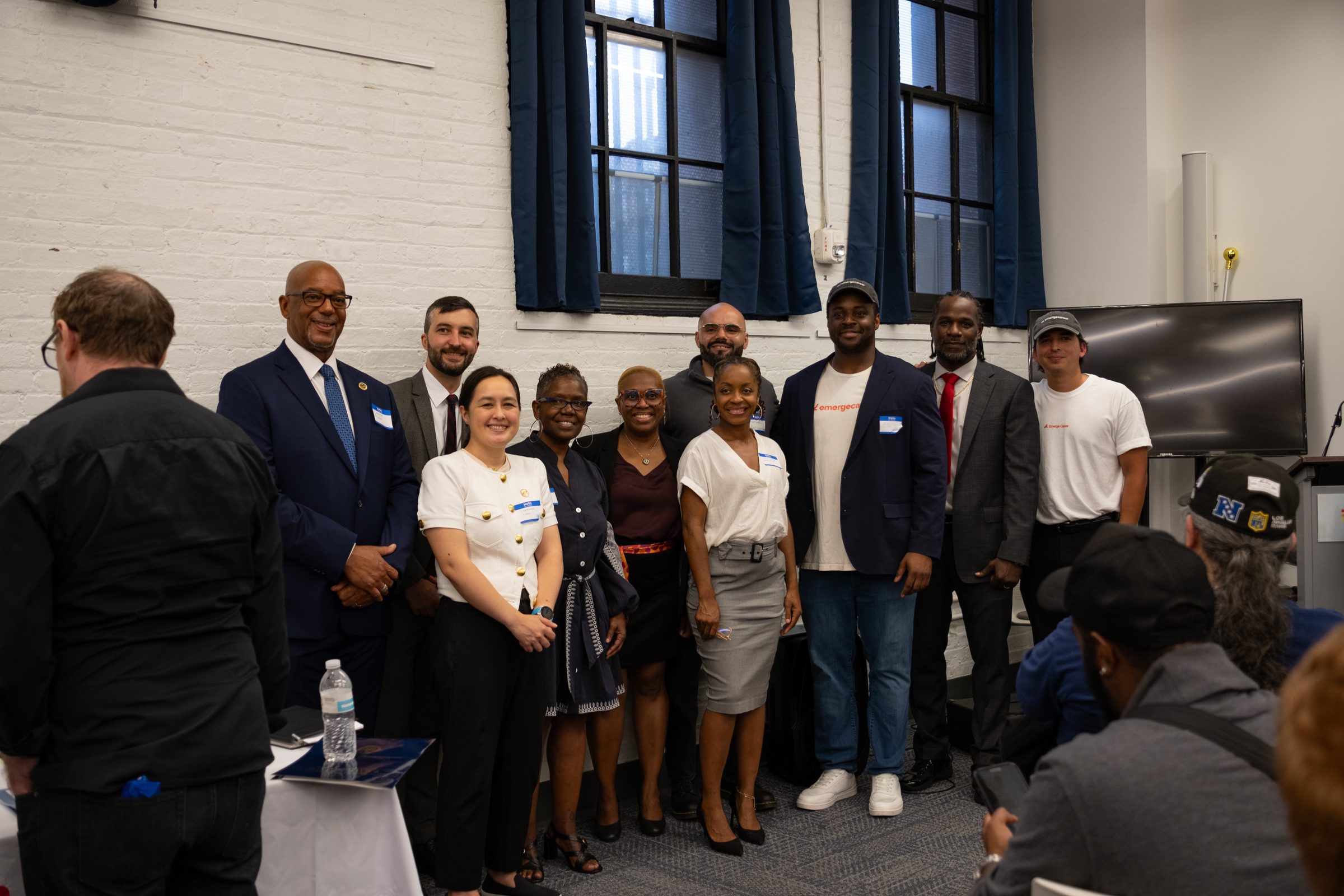
BROOKLYN, N.Y. — September 3, 2026 — Emerge Career, a leading workforce development technology company, and the New York City Mayor's Office of Criminal Justice (MOCJ) yesterday hosted the Next Mile NYC Economic Opportunity Summit at the Brooklyn Community Pride Center, convening elected officials, city agency leaders, major employers, and justice-involved New Yorkers to showcase how the city can deliver economic opportunity and expand access to skilled trades careers for underserved New Yorkers. Graduates were hired or offered pre-hire letters on the spot while hundreds were connected with employers.
The summit featured over 200 attendees across the evening, including remarks from MOCJ Director Deanna Logan, Department of Probation Commissioner Sharun Goodwin, Department of Correction Commissioner Stanley Richards, Department of Citywide Administrative Services Commissioner Yume Kitasei, NYC Office of Talent and Workforce Executive Director Doug Lipari, and NYC Council Member Selvena Brooks-Powers, and highlighted Next Mile NYC’s track record of training and placing hundreds of justice-involved individuals in CDL/trucking and diesel technician careers. The packed event and opening remarks showcased the success and innovation of Next Mile NYC, delivering economic opportunity and mobility for hundreds of justice-involved New Yorkers through skilled trades careers. The event also highlighted the program’s innovative, outcome-based model which was developed by Emerge Career and MOCJ to improve upon the standard structures and funding of the city’s workforce programs to date, rewarding outcomes — credentials, placements, and wage growth — rather than program enrollment alone.
"We were thrilled to bring together our partners across the city to show the power of our work. Next Mile NYC is bringing real, tangible second chances – rooted in careers, not just credentials – to New Yorkers. Each agency partner showed how tremendous the impact can be when we work together. Emerge is delivering outcomes by the hundreds across the city and solving critical workforce challenges." said Zo Orchingwa, Emerge Career Co-CEO.
“Access to lucrative career opportunities changes the entire trajectory of an individual’s life and benefits their community," said Deanna Logan, Director of MOCJ. "We’re proud to partner with Emerge Career to give more New Yorkers the chance to succeed. Next Mile NYC gives individuals the ability to garner skills that lead to lasting careers, creating a path forward for the individual, their families, and strengthens our city.”
Panelists for the policy summit included Samantha Kleinfield of MOCJ, Safiya Baptiste-Taylor of HRA, Trey Reid of PINCC, and Colette Grant of DYCD who highlighted the ways the city can strengthen its supports for underserved populations, increase visibility into student employment outcomes, and improve the delivery of careers, not just jobs. Next Mile NYC achieves all three: rigorous transparency across the student journey through placement and retention, wraparound supports, and life-changing careers that deliver many six-figure careers with entrepreneurial opportunities.
The cross-city participation was on full display with representation from The Mayor’s Office, theNYC Department of Probation, the NYC Department of Correction, the NYC Department of Citywide Administrative Services, the NYC Office of Talent and Workforce, the NYC City Council, the NYC Economic Development Corporation, the NYC Department of Youth and Community Development, and NYC Human Resources Administration, among others.
The summit also featured firsthand accounts from Emerge Career graduates now working in skilled trades careers making an average of $75,000, underscoring the economic mobility possible when training programs are paired with direct employer partnerships.
“At the Department of Probation, we know that opportunity is essential to creating lasting pathways forward,” said NYC Department of Probation Commissioner Sharun Goodwin. “Next Mile NYC is about connecting New Yorkers to skills, credentials and employers that can lead to family-sustaining careers and greater economic stability. By working alongside our partners across government and the private sector, we are helping our clients turn potential into opportunity and build stronger futures for themselves, their families, and their communities.”
“Whenever someone comes into contact with the criminal legal system, all of us in government have an opportunity, and a responsibility, to help build on-ramps to better futures,” said NYC Correction Commissioner Stanley Richards. “And that is exactly what programs like these can achieve. Everyone who has engaged is charting a new path and showing the world what is possible when we invest in people — and when people invest in themselves.”
"Jobs with the city are some of the best in the nation with competitive pay and fantastic benefits, and much like the mission of the Next Mile program, at DCAS we are working to break down barriers to employment," said DCAS Commissioner Yume Kitasei. "We are proud to have joined Next Mile and our sister agencies for the Economic Opportunity Summit, and we encourage any New Yorker looking for work to consider municipal employment with the City of New York."
“Today’s summit highlights the value in removing barriers and not overlooking untapped talent. By bringing together employers, jobseekers, and City leaders, we are forging career pathways for justice-impacted New Yorkers," said NYC Office of Talent and Workforce Development Executive Director Doug Lipari. "Thanks to the collaboration between MOCJ and Emerge Career, we are ensuring that New Yorkers with valuable CDL skills gain direct access to careers in transportation."
“If we want New Yorkers returning from the justice system to stay on the right path, it is the responsibility of all of us to create paths available to them,” said Council Member Selvena Brooks-Powers, Chair of the Committee on Criminal Justice. “Through training, licensing, and direct connections to possible careers, Next Mile NYC represents a model for what is possible when government and employers work together to remove barriers and invest in workers. I wish success for every graduate, every person taking their first step on this journey, and a special thank you to Emerge Career for opening doors that for too long have been kept closed.”
For media inquiries, please contact Noah Pransky, press@mocj.nyc.gov, or Jason Barefoot, jason@emergecareer.com.
About Emerge Career
Emerge Career is an AI-powered workforce development platform and public benefit corporation that trains and places underserved Americans in skilled trades careers, including CDL/trucking, HVAC, and diesel mechanics.
About the Mayor's Office of Criminal Justice
The Mayor’s Office of Criminal Justice makes NYC communities safer — and the justice system more fair — with data-backed initiatives and equitable solutions.
Emerge Career Went to Fortune's 2026 Tech Fair: From Demo to the Main Stage
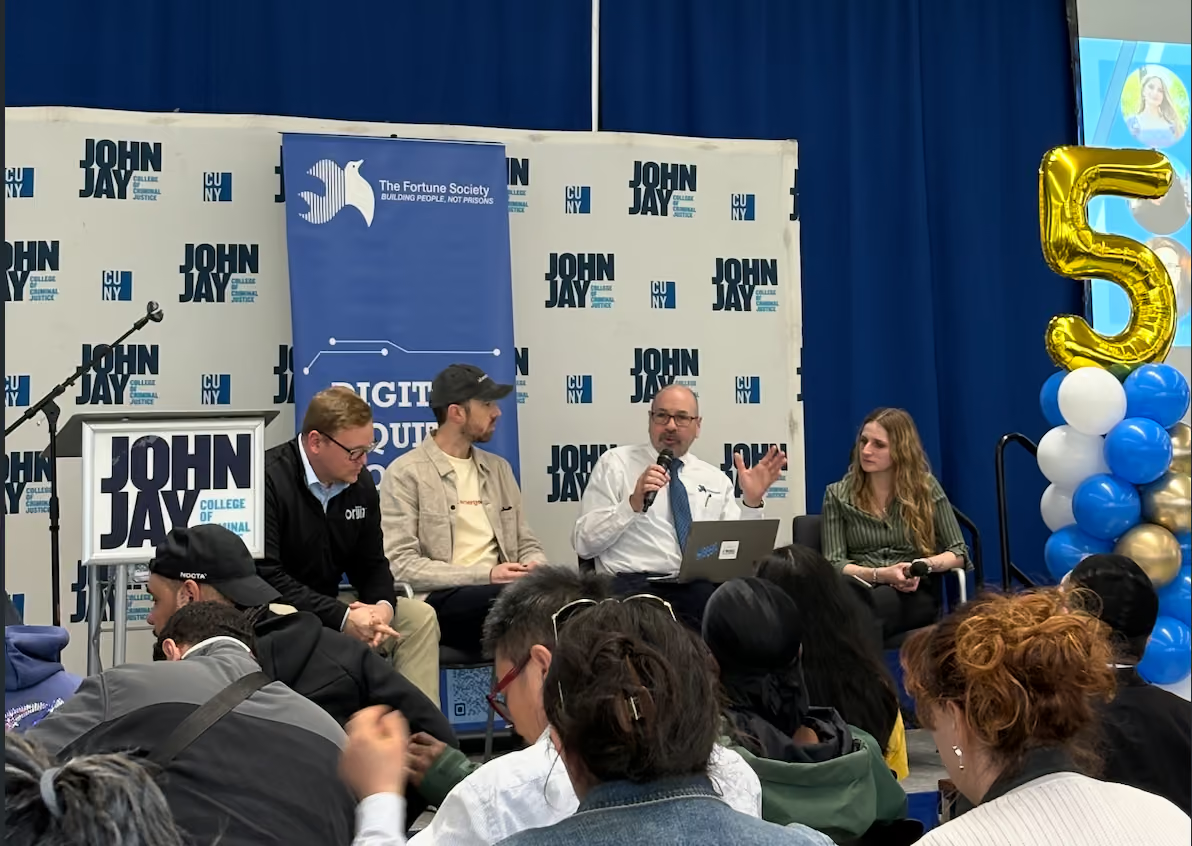
From demo to the main stage, on Wednesday morning around 10am, I set up a demo table for Emerge Career at the Fortune Society's 5th Annual Tech Fair. By the afternoon, I had over 20 business cards in my pocket, 10 warm intros, and was on stage speaking to hundreds of participants.
On Wednesday morning around 10am, I set up a demo table for Emerge Career at the Fortune Society's 5th Annual Tech Fair. By the afternoon, I had over 20 business cards in my pocket, 10 warm intros, and was on stage speaking to hundreds of participants.
That's not something I planned. In fact, I asked many times for an opportunity to speak about the amazing work we are doing and was kindly told there wasn't enough space.
But I stayed patient, and optimistic. I felt confident that once people saw and heard about our work, they'd want to get involved and help spread the word, and the work. And I was right. The room recognized what this work is doing across the country.
This year's fair, themed "Using Tech to Rebuild Lives," brought together justice-involved New Yorkers, reentry professionals, and government leaders at John Jay College's Institute for Justice and Opportunity. The energy in that room asked one question louder than any panel ever could: What does a real career pathway look like after incarceration? At Emerge Career, our answer is opportunities in the skilled trades. HVAC technicians. CDL drivers. EV technicians. Diesel mechanics. Electricians. These are careers that AI isn't replacing anytime soon, and in most cases careers where employers are competing more and more aggressively for talent because the demand for labor for exceeds the existing supply.
Our graduates, all of whom are justice-involved, are entering the workforce at $80,000+ starting salaries. Read that again. Over $80,000 for someone with justice involvement is life changing. Not just a safety net, but a foundation. That's on par with a Yale graduate from last year.
None of this happens in a vacuum. It happens because Emerge works with our government partners to build the infrastructure that makes it possible. Agencies like the NYC Mayor's Office of Criminal Justice and the Sacramento Employment and Training Agency don't just check a workforce development box, they change the entire reentry equation. They create the conditions for someone to walk out of incarceration and into a career, not just a job.
That shift, from placement to pathway, is what transforms a program into a movement. To the agencies, workforce development boards, and government offices championing this kind of work: you deserve more public recognition than you receive, but here's some from our recent grads in the meantime. What you are doing is quietly transformative, for individuals, for employers, and for the cities we all share. The reception Emerge Career received at the Tech Fair was a reminder that the ecosystem is ready. Employers are ready. The talent is ready. What we need now is more programs like this, and more partners with the vision and commitment to fund them. I'm proud to be part of it.
Special thanks to The Fortune Society and John Jay College's Institute for Justice and Opportunity for creating a space where this work can speak for itself. And to the NYC Office of Technology and Innovation, Tech:NYC, the NYS Digital Equity Network, and the NYC Alliance for Digital Equity for making the event possible.
Emerge Career Launches Monthly Partner Roundtable — And the Response Was Electric
Nine community organizations across Massachusetts and New York joined our first-ever CBO Partner Roundtable — and the conversation made one thing clear: the demand for workforce training built around justice-involved individuals is only growing.
Emerge Career Launches Monthly Partner Roundtable — And the Response Was Electric
Published: April 2026
Nine community organizations across Massachusetts and New York joined our first-ever CBO Partner Roundtable — and the conversation made one thing clear: the demand for workforce training built around justice-involved individuals is only growing.
On April 16, Emerge Career hosted its inaugural Partner Roundtable — a monthly virtual convening designed to bring together the community-based organizations, government agencies, and workforce partners who refer participants to our training programs.
The goal was simple: get everyone in the same room, share what's new, and make it easier for our partners to connect their clients to opportunity. What happened exceeded expectations.
Who Showed Up
Nine organizations joined from across two states, representing probation departments, reentry programs, youth services, substance use recovery, and workforce development:
- NYC Department of Probation / Neighborhood Opportunity Network (NEON) — New York City
- America Works — New York (national)
- Housing Works Justice Initiative — New York City
- Neighbors in Action / Center for Justice Innovation — New York City
- Mayor's Office of Returning Citizens — City of Boston
- Legendary Legacies — Worcester, MA
- Worcester Youth Center — Worcester, MA
- Institute for Health and Recovery, ATR Program — Boston, Lowell, and Springfield, MA
That's a room full of people doing the hard, daily work of meeting justice-involved individuals where they are — and helping them build something new.
What We Heard
Three themes came through loud and clear.
1. The demand for trades training goes way beyond CDL.
Nearly every partner on the call asked the same question: When are HVAC and diesel tech coming to my area? Our CDL program has been the foundation, but partners are telling us their clients want more options — especially participants who face barriers to obtaining a commercial driver's license. We're actively pursuing funding to bring additional vocations to both Massachusetts and New York, and the roundtable reinforced just how urgent that expansion is.
2. Proximity matters.
Our Boston-area partners were candid: the distance to our current Western Massachusetts training sites is a real barrier for their clients. We heard them. Finding the right space for a Boston-area training center is a top priority, and we're actively exploring locations and funding partnerships to make it happen. The same goes for New York City, where we're working toward a training center within the five boroughs.
3. This network is stronger than any single organization.
The most energizing part of the roundtable wasn't the updates from Emerge — it was hearing partners learn about each other. Organizations serving probation populations discovered peers working in substance use recovery. Youth-focused programs connected with city agencies doing employer engagement. The roundtable created space for cross-referrals and collaboration that wouldn't have happened otherwise.
Program Updates We Shared
We used the roundtable to spotlight two of our newest programs:
HVAC — Our existing HVAC program is enrolling now in Massachusetts, covering EPA 608 certification, split system installation, furnace diagnostics, refrigeration, and controls. We're actively pursuing funding for a dedicated training site that would allow us to scale capacity significantly.
Diesel Technician — We're on track to register one of Massachusetts' first Diesel Technician Registered Apprenticeship Programs. The structure is a three-year, 6,000-hour program with Emerge delivering the first-year pre-apprenticeship and an employer sponsor providing on-the-job training for years two and three. Pre-apprenticeship referrals are open now.
What Comes Next
The Partner Roundtable is now a monthly fixture — every third Thursday at 2:00 PM ET. Our next session is May 21, 2026.
We also sent every attending organization a formal partnership agreement (MOA) to make it easier to collaborate on referrals and joint funding applications. When our partners are stronger, our participants get better outcomes. That's the whole point.
If your organization serves justice-involved individuals and you're interested in joining the roundtable or learning more about referring clients to our programs, reach out to us at elizabeth@emergecareer.com.
Emerge Career is a Public Benefit Corporation providing workforce training — CDL, HVAC, Diesel Technician, and Construction Trades — primarily for justice-involved individuals. We operate in Massachusetts, New York, California, and Colorado with over $13 million in active contracts.
Jobs for Felons: Fair-Chance Careers and How to Get Hired
Second-chance jobs are ordinary jobs at employers who consider people with records. Here is how employers decide, which careers open fastest, and what our own placement numbers look like.
Emerge Career gets people free training and real jobs in the trucking, diesel mechanic, and HVAC industries. To apply for our program, click here.
Written by Gabriel Saruhashi, co-founder of Ameelio. LinkedIn profile. Last reviewed September 2026.
If you are searching for jobs for felons, or for second-chance jobs, you are asking the right question at the wrong level. The question is not whether anyone hires people with records. They do, every week. The question is which employers, for which roles, and what you need in hand before you apply.
The short answer
People with felony convictions get hired into skilled trades work, and the pay is not entry-level pay.
You do not have to take our word for the numbers. CBS News reported in May 2025 that in fiscal year 2024, 94% of participants in our New York City program graduated, every graduate received a job offer, and the average starting salary was $75,000. At that point 260 formerly incarcerated people had completed it.
Our own cohort records say the same thing. In Connecticut, 30 students enrolled, 94% graduated, and 100% were placed, at an average starting base of $75,313. In Denver, 15 students enrolled and all of them graduated and were placed, at an average base of $76,000.
One of our graduates, Iovanny M., went from $12,000 a year on food stamps to more than $100,000 a year in under twelve months. He is in a union job with full benefits.
Those are small cohorts. We are not claiming they predict your outcome. We are saying the door is open, and we can show you who walked through it.
What counts as a second-chance job
A second-chance job is one where the employer considers applicants with criminal records instead of screening them out automatically. Some people call it fair-chance hiring. The two terms mean the same thing.
It does not mean the employer ignores your record. It means they weigh it alongside everything else, and a conviction on its own does not end the application.
Second-chance jobs are not a separate category of work. They are ordinary jobs at employers who decided to hire this way. Most of the ones our graduates take are driving, waste hauling, transit, and skilled trades roles.
No employer is a permanent second-chance employer. Policies change with leadership, insurance, and the role being filled. That is why the section on checking a policy below matters more than any list you will find online.
What actually decides a hiring decision
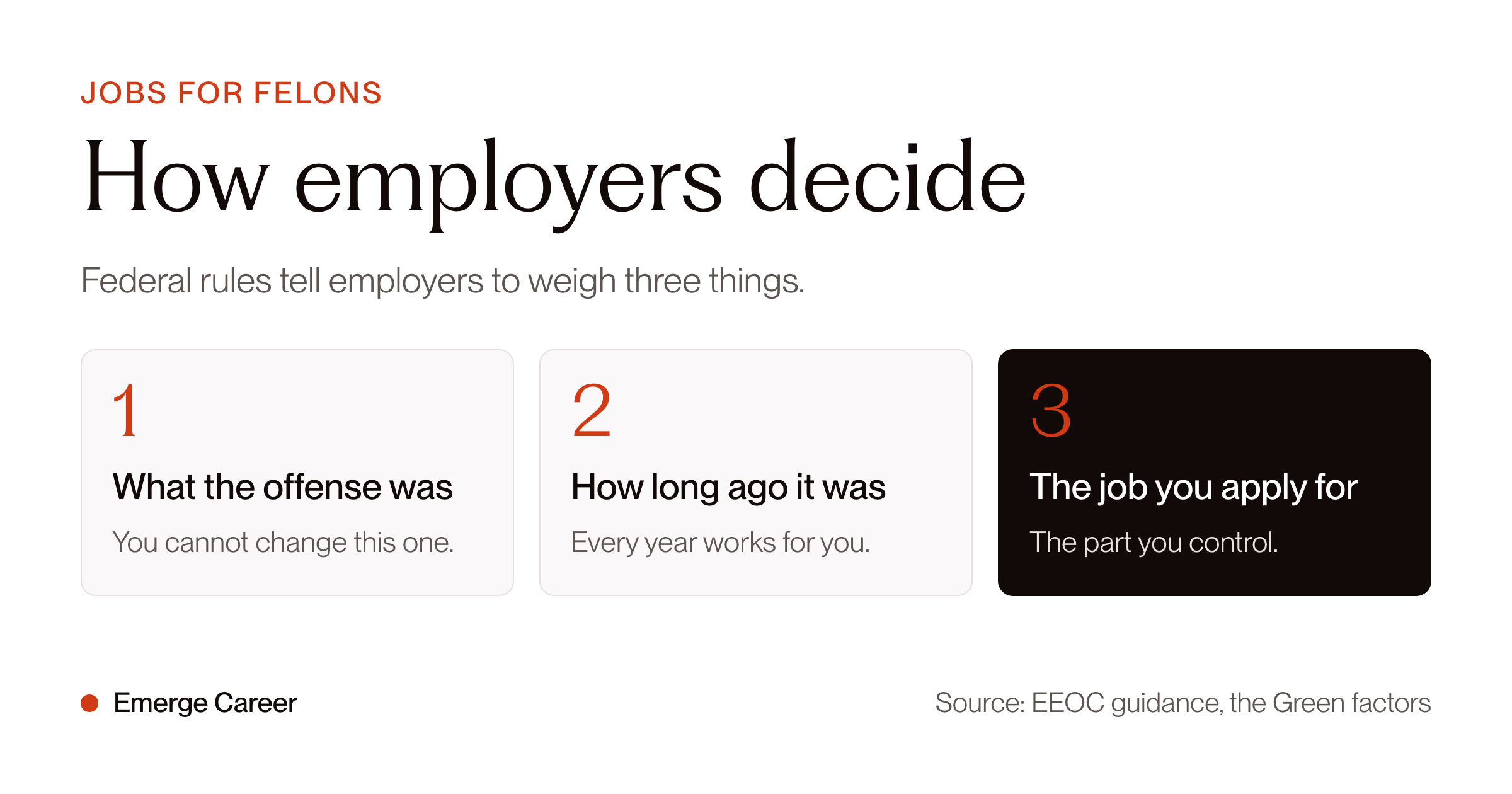
Federal guidance tells employers what to weigh. The Equal Employment Opportunity Commission points to three factors, known as the Green factors:
- The nature and gravity of the offense.
- The time that has passed since the offense or since you finished your sentence.
- The nature of the job you are applying for.
The same guidance says employers should give you a chance to explain your circumstances before they rule you out. That is called an individualized assessment. The EEOC lists what it should take into account: the facts of the offense, your work history since, evidence of rehabilitation, character references, and whether you are bondable.
Two of those three factors you cannot change. Time passed is the one that moves in your favor every month. The third one, the nature of the job, is the one you control right now by choosing what to apply for.
Careers you can start in weeks
Skilled trades hire on licenses and tests rather than on degrees and referrals. That works in your favor.
Commercial driving
There is real demand behind this one. The American Trucking Associations put the industry shortage at about 60,000 drivers when CBS News covered our program. Our graduates average $75,000. The licensing rules are federal and public, so you can check your own eligibility before you spend anything. See CDL requirements.
One thing to know up front: a felony conviction does not bar you from a CDL by itself. The federal rule turns on whether a commercial vehicle was used in the offense. Employer policy is a separate gate, and so is the security screening for a hazardous materials endorsement.
Diesel mechanic
Shops hire on skill, and the work is inside a facility rather than on a customer doorstep. That removes an objection some employers raise. See diesel mechanic jobs.
HVAC
Licensed work with apprenticeship hours built in, so you earn while you qualify. See HVAC jobs.
Employers who have hired our graduates
Named employers, what they told us, and the date we last checked.
Four employers at the Next Mile Economic Opportunity Summit
On September 2, 2026 we ran the Next Mile Economic Opportunity Summit. Four employers sent representatives to meet graduates in person:
- Cream-O-Land Dairy, represented by Daviani Cordero
- Gate Group, represented by Daniela Meza
- MTA, represented by Patrick Densen
- Swissport, represented by Mark Walker
Daniela Meza of Gate Group described the experience level they look for: "We're looking for somebody who has a little bit of experience but not a lot." Gate Group had already hired an Emerge graduate, Daryl Lopez. In her words, he was given the opportunity "because he seemed like he would be a good fit into our operation."
One of the four employers had three more graduates starting the next day: Jamal, Kevin, and Patrick.
Another put the screen plainly: "We just need your skill and compliance. Everything else works itself out, because what we try to do is we try to promote success."
A third explained why they came: "We're a company about giving second chances. So this kind of fit that bill." That recruiter spoke with more than 50 people over the day, and said the reason was personal: "I've been given opportunities, and because I was given those opportunities, I want to pay it forward."
Last verified September 2, 2026.
Interstate Waste Services
We ran a CDL hiring event at the Brooklyn Public Library on April 16, 2026. Forty-eight students showed up. Interstate Waste Services collected more than 30 resumes that day and hired two graduates within weeks. They then committed to hiring at least 50 more through a Driver Helper to CDL Driver pathway, which lets someone start before they hold the license and move up once they do. David Brown Sr., MBA, their Director of Safety, drove that partnership.
Metropolitan Transportation Authority
An MTA recruiter, Shariza Baksh-Ramroop, left one of our New York hiring events with 10 resumes. Five graduates advanced to interviews and four went into the bus operator track. Three Emerge graduates were already on staff before that event.
Every one of these came out of an in-person hiring event rather than an online application. That is the pattern worth copying.
How to find fair-chance employers
Four channels work better than scrolling job boards.
- Hiring events run by training programs. The recruiter is in the room because they already decided to consider people with records.
- Industries with driver or technician shortages. Waste hauling, transit, freight, aviation services, and facilities maintenance all hire on skill.
- State workforce agencies. They administer the bonding and tax credit programs employers use, so they know which local employers use them.
- Reentry organizations in your city. They keep current lists because their funding depends on placements.
Job boards are worth less than any of these, because a posting tells you nothing about the policy behind it.
How to check what a policy really is
Ask the recruiter directly, early, before you invest a week in an application. A short version that works:
"I have a felony conviction from [year]. I have my CDL and a clean driving record. Does your company consider applicants with records, and is there anything about the offense or the timeframe that would rule me out here?"
A real answer sounds specific. It names a lookback period, or an offense category, or says the decision goes to a review. A brush-off sounds like "we consider everyone on a case-by-case basis" with nothing after it. Take the specific answer seriously and keep moving past the vague one.
When to bring up your record
Many states and cities have ban-the-box laws that stop employers from asking about convictions on the initial application. The rules differ by where you live, and by employer size. Check your own state law rather than assuming.
Practical version: do not lead with it, do not hide it, and do not let the background check be the first time they hear about it. Bring it up once you have shown what you can do, and keep it to two sentences. What happened, when, and what you have done since. Then move to the work.
If your background report is wrong
Background reports carry errors. Sealed cases show up. Charges that were dismissed get reported as convictions. Records belonging to someone with a similar name get attached to yours.
Under the Fair Credit Reporting Act, an employer has to give you a copy of the report and a notice before they reject you over it. That notice is your opening. Dispute the error with the screening company in writing, keep a copy, and tell the employer you have filed a dispute.
Pull your own record before you start applying. Fixing an error takes weeks, and it is better to spend those weeks before an offer is on the table.
Programs that make employers say yes
Employers respond to risk and cost. Two federal programs address both, and knowing their names in an interview is worth more than it sounds.
The Work Opportunity Tax Credit is a federal tax credit for employers who hire people from target groups that face barriers to employment. The employer has to get certification that you belong to a target group before they claim it. Our employer page puts the typical credit at around $6,000 per person.
The Federal Bonding Program provides fidelity bond coverage at no cost to the employer, which covers them against loss for an at-risk new hire. The EEOC guidance lists bonding as one of the things an employer should weigh in an individualized assessment.
You can raise both. "I am WOTC eligible and I can be bonded" turns your record into a line item the employer can account for.
What Emerge does
We train people for CDL, diesel mechanic, and HVAC work, and the training is free. We have graduated more than 500 people across three states.
Our New York City program runs with the Mayor's Office of Criminal Justice. CBS News covered it in May 2025, and NBC News has reported on the program as well.
Every student gets a Student Success Coach for the first year on the job, not just until placement. We run hiring events where employers show up to meet graduates in person.
Angel G. of Haverhill, Massachusetts was incarcerated nine years before he came to us. Joe G. of Staten Island said he chose Emerge because we gave an opportunity to people with records that other programs did not.
To check whether you qualify, use the link at the top of this page.
Questions people ask
What is a second-chance job?
A job at an employer who considers applicants with criminal records rather than screening them out automatically. Fair-chance hiring is the same thing under a different name.
Can a felon get a CDL?
Yes, in most cases. The federal disqualification rules turn on whether a commercial vehicle was used in the offense. Employer policy and hazmat screening are separate questions.
How long do I have to wait after a conviction?
There is no single waiting period. Time elapsed is one of the three factors the EEOC tells employers to weigh, so the answer improves the further out you are.
Do I have to tell an employer about my record?
If they ask, yes. Lying about it is the thing most likely to cost you the job after you have it. Ban-the-box laws in many places delay when they can ask.
Which industries hire the most people with records?
In our experience: freight, waste hauling, transit, aviation services, warehousing, construction, and facilities maintenance.
What if the background check shows something wrong?
Dispute it with the screening company in writing. Under federal law the employer has to give you the report and a notice before rejecting you over it.
Is Emerge training actually free?
Yes. The program is government funded and costs students nothing.
Sources
- CBS News, Jobs program for the formerly incarcerated seeks to address U.S. trucking industry shortage, May 21, 2025. Fiscal year 2024 graduation rate, job offers, average starting salary, completions to date, and the driver shortage figure.
- U.S. Equal Employment Opportunity Commission, Enforcement Guidance on the Consideration of Arrest and Conviction Records in Employment Decisions. The three Green factors and the individualized assessment.
- U.S. Department of Labor, Work Opportunity Tax Credit. Target groups and the certification requirement.
- Federal Bonding Program. Fidelity bonding for at-risk hires.
- Next Mile Economic Opportunity Summit, September 2, 2026. Employer representatives on the record: Daviani Cordero (Cream-O-Land Dairy), Daniela Meza (Gate Group), Patrick Densen (MTA), Mark Walker (Swissport). Video.
- Emerge Career, Interstate Waste Services partnership. Event date, resume count, hires, and the Driver Helper pathway.
- Emerge Career, MTA partnership. Recruiter, resume count, interviews, and graduates on staff.
- Emerge Career, Impact. Connecticut and Denver cohort sizes, graduation rates, placement rates, and starting salaries.
CDL Requirements: Permit, Medical, Training, and Testing
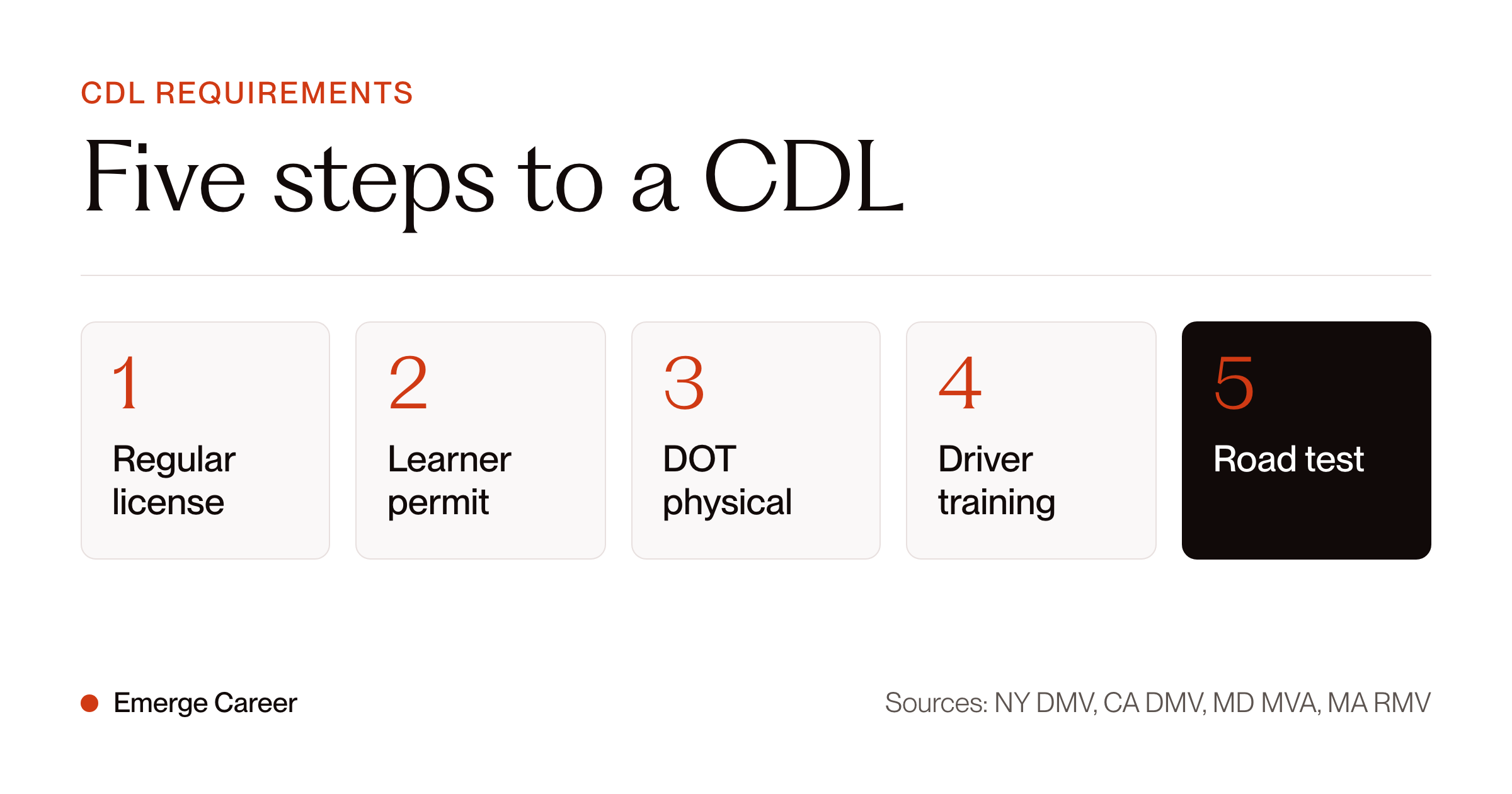
A CDL takes five things: a learner permit, a DOT physical, entry-level driver training, a knowledge test, and a skills test. Here is what each one requires in New York, California, Maryland, and Massachusetts, what it costs, and how long it takes.
Emerge Career gets people free training and real jobs in the trucking, diesel mechanic, and HVAC industries. To apply for our program, click here.
Written by Gabriel Saruhashi, co-founder of Ameelio. LinkedIn profile. Last reviewed September 2026.
What do I need to get a CDL?
To get a commercial driver license you need five things.
- A regular driver license from the state where you live.
- A commercial learner permit, which you pass a written test to get.
- A DOT medical exam and a medical certificate.
- Entry-Level Driver Training from a school on the federal registry.
- A passing score on the road test, which you can take after you have held the permit for 14 days.
Your state issues the license. The federal government sets the floor that every state has to meet.
Who sets CDL requirements?
Two sets of rules apply at the same time.
The Federal Motor Carrier Safety Administration sets the minimum. Age limits, the medical exam, the training requirement, and the 14-day permit wait are the same in every state. No state can drop below them.
Your state motor vehicle agency runs the process. It decides what documents you bring, what you pay, how many times you can retake a test, and how long your permit stays valid. Those parts differ, and they are the parts that trip people up.
Check your own state before you plan around anything in this guide. The four states we work in are covered below.
How old do I have to be, and what license do I need first?
You must be 18 to drive a commercial vehicle inside your own state. You must be 21 to cross state lines, carry hazardous materials, or carry passengers. Maryland and Massachusetts both state these limits directly.
Most jobs that pay well are interstate jobs. If you are under 21, plan for local work first.
You also need a regular license already in hand. New York asks for a Class D, Class E, or Non-CDL C license. California asks for a noncommercial Class C license. Maryland asks for a valid full Maryland license. Massachusetts asks for a Class D license that stays valid for the whole life of your permit.
Every state asks for proof of who you are. That means identity, date of birth, Social Security number, and proof that you live in the state. Massachusetts adds two conditions that catch people out. You cannot hold a driver license in another state, and you have to be clear of outstanding obligations to any state.
Do I need a Class A, Class B, or Class C CDL?
The class you apply for depends on the vehicle you plan to drive.
Class A
Combination vehicles. A tractor-trailer is the common example. This is the class with the widest range of jobs and the highest pay.
Class B
Heavy straight vehicles. Box trucks, dump trucks, and large buses. The vehicle is one piece instead of a tractor pulling a trailer.
Class C
Smaller vehicles that carry hazardous materials, or that carry 16 or more passengers.
Most Emerge students train for Class A because it opens the most work. See CDL jobs for what each class pays.
When do I get my Commercial Learner's Permit?
The permit comes first. You study the commercial driver manual for your state, then take a written knowledge test at a motor vehicle office.
Once you have the permit, you have to hold it before you can take the road test. California states the rule as holding the permit for at least 14 days. New York states it from the other side: you cannot schedule a road test within 14 days of the day your permit was issued. Both come from the same federal rule.
Permits expire. California issues a permit good for a maximum of 180 days and lets you renew it once for another 180 days, as long as that falls inside one year of your first application. California also voids the whole application if you have not finished within 12 months.
What happens at the DOT physical?
You need a medical exam from an examiner listed on the federal National Registry. The examiner fills out two forms: the Medical Examination Report, form MCSA-5875, and the Medical Examiner Certificate, form MCSA-5876. California names both forms in its application steps.
The exam covers vision, hearing, blood pressure, and conditions that affect your ability to drive safely. Some conditions do not stop you. They require extra paperwork or a shorter certificate.
Book this early. A medical issue you did not know about is the most common reason a timeline slips.
What is Entry-Level Driver Training?
Entry-Level Driver Training, or ELDT, became federal law on February 7, 2022. You have to complete it at a provider listed on the FMCSA Training Provider Registry. A school that is not on the registry does not count.
ELDT applies when you are getting a Class A or Class B CDL for the first time, upgrading from Class B to Class A, or adding a passenger, school bus, or hazardous materials endorsement for the first time.
The timing differs by what you are applying for. For a road test, you finish ELDT first. For a hazardous materials endorsement, you finish ELDT before the knowledge test, not before the road test. Maryland and Massachusetts both state this split.
Check the registry before you pay any school. Emerge covers training at licensed schools for students in our program.
What tests do I have to pass?
The knowledge test comes first and gets you the permit. Massachusetts requires a general knowledge exam, plus a combination vehicle exam if you are going for Class A, plus a hazardous materials or passenger exam if you are going for Class C.
You do not get unlimited tries. California gives you three attempts at each knowledge test. Fail the same test three times and your application is dead, so you start over and pay again.
New York offers written tests in English, Spanish, Chinese, and Russian. The hazardous materials test is English only.
The road test has three parts. A pre-trip inspection, where you walk the vehicle and name what you are checking. A basic control skills test, which is backing and maneuvering. A road test in traffic.
The pre-trip inspection fails more people than the driving does. It is memorization, and it rewards practice.
Failing a test is not the end of it. Ka-son Davis, a graduate from Manhattan, failed a test during his training and went on to get his license. "They like, no listen, we still going to help you. Just as long as you keep pushing, then we going to guide you there."
What are the CDL requirements in New York, California, Maryland, and Massachusetts?
These are the state-run parts. Everything else follows the federal rules above.
| Requirement | New York | California | Maryland | Massachusetts |
|---|---|---|---|---|
| License you need first | Class D, Class E, or Non-CDL C | Noncommercial Class C | Valid full Maryland license | Class D, valid for the life of the permit |
| Age | Federal limits apply | Federal limits apply | 18 in state, 21 interstate, hazmat, passengers | 18 in state, 21 interstate |
| Wait before road test | Cannot schedule within 14 days of permit | Hold permit at least 14 days | ELDT first | ELDT first |
| Permit test fee | $10 | Application fee, valid 12 months | Not listed | $30 |
| Road test fee | $40 | Not listed | Not listed | Not listed |
| Endorsement fee | Not listed | Not listed | Not listed | $10 with permit, $30 later |
| Retakes | Not listed | 3 per knowledge test, then reapply | Not listed | Not listed |
| Permit validity | Not listed | 180 days, one 180-day renewal | Not listed | Not listed |
| Background step | Fingerprints. Surrender any out-of-state CDL | 10-Year History Record Check, form DL 939 | Proof of identity, age, SSN, residency | No license in another state. No outstanding obligations |
The New York page does not state age limits or ELDT on its main CDL page. The federal rules still apply. Confirm the current fees with your own state before you budget.
What can disqualify me from a CDL?
Maryland publishes the clearest list. Your CDL can be disqualified if you get a citation for a high blood alcohol concentration while driving a commercial vehicle, and that happens before any conviction. It can be disqualified if you refuse or fail a chemical test for alcohol. It can be disqualified by a conviction, or by probation before judgment, on certain violations.
If Maryland sends you a disqualification notice, you have 15 days to return it. You can request a hearing, or give up the hearing and surrender the license.
Short disqualifications of 60, 90, 120, or 180 days let you apply for reinstatement without retaking the knowledge and skills tests. Longer ones do not.
Can I get a CDL with a criminal record?
Yes, in most cases. This is the question we get most, and the answer has three separate parts that people run together.
The license
Federal law only bars you from a CDL if you used a commercial vehicle in your offense. Offenses committed in a commercial vehicle carry specific disqualification periods. An offense that had nothing to do with a commercial vehicle does not bar you by itself.
The employer
A carrier can set its own hiring policy, and most do. Policies vary by the offense, how long ago it was, and the route. This gate is separate from the license, and it is the one that decides whether you get hired.
The security screening
A hazardous materials endorsement requires a federal security threat assessment through the Transportation Security Administration. That screening has its own disqualifying offense list, and it is stricter than the CDL rules. You can hold a CDL and still be denied a hazmat endorsement.
Getting the license and getting hired are two different problems. Emerge's employment coaches help students navigate both. We cover the second one in jobs for felons.
How much does a CDL cost, and how long does it take?
Published state fees are small. New York charges $10 for the permit test and $40 for the road test. Massachusetts charges $30 for the permit application.
Training is the real cost. Private CDL schools generally run several thousand dollars, and that is the number that stops most people.
How long it takes depends on whether you can train full time. Ka-son Davis started with Emerge in October 2025. His permit took about a month, because he was working at the same time and had to fit studying around it. Getting the CDL itself took another five to six months.
If you can train full time, pass each test on the first attempt, and get appointments without a wait, seven to twelve weeks is achievable. Working through it, or retaking a test, pushes it closer to Ka-son's six months. Appointment backlogs are the other common delay. Plan for the longer end and treat the short end as the best case.
Ka-son is a single father and wants local work rather than long haul, for the stability. "I'm looking for a career that's got longevity, so I can take care of my kids."
Emerge Career covers training for students in our program at no cost. Our graduates average $75,000 a year. Check whether you qualify at the link at the top of this page.
Sources
- New York State Department of Motor Vehicles, Get a CDL. Permit test fee, road test fee, prerequisite license, 14-day road test rule, test languages, fingerprinting.
- California Department of Motor Vehicles, Commercial Driver Licenses. Permit application steps, 14-day hold, medical forms MCSA-5875 and MCSA-5876, form DL 939, three-attempt limit, 180-day permit validity.
- Maryland Motor Vehicle Administration, Get or renew a CDL. Age limits, vehicle classes, ELDT registry requirement and hazmat timing.
- Maryland Motor Vehicle Administration, Disqualification and reinstatement. Disqualifying events, 15-day notice, reinstatement periods.
- Massachusetts Registry of Motor Vehicles, Apply for a Commercial Learner Permit. Age limits, prerequisite license, residency and obligation rules, exam list, ELDT effective date, permit and endorsement fees.
- Federal Motor Carrier Safety Administration, Commercial Driver License program and the Training Provider Registry.
- Ka-son Davis, Emerge Career graduate, interviewed at the Next Mile Economic Opportunity Summit. Permit and licensing timeline, and retaking a failed test. Video.