Local Involvement
Policy work, employer partnerships, and what the program looks like on the ground in each city.

Building the AI That Builds Second Chances
Liz Phillips is RFP Lead at Emerge Career.
Last week our team had something we call Claude & Tell — an internal show-and-tell where someone walks the rest of us through what they've been building with AI. It was my turn. I demoed the custom skills I've been writing in Cowork to automate the RFP work I now own. One of my colleagues said something I haven't been able to put down since: that's an Emerge journey story; you should write about it.
So I'm writing about it.
Two years ago, I applied for this job at Emerge Career. They said no.
How I got here
I spent five years in prison. While I was there, I went to college through Ashland University, took notes by hand, and wrote my essays on a tiny keyboard hooked into a tablet on weekends and at night.
I also had a tech job inside — Televerde, a company that operates call centers inside U.S. prisons. One of the only websites we could reach on the work terminals was Fortune.com. That's where I first read about ChatGPT. An officer walked past while I was doing my schoolwork one day and said, “Too bad you guys are in here doing school the hard way — now there's ChatGPT.” He meant it as a joke. I took it as a tip.
When I came home, I used the only tool I'd started to understand. I used ChatGPT to write my resume, to prep for interviews, to structure my thinking when I sat down to apply for jobs.
In March 2024, I applied for a state engagement role at Emerge Career. I used ChatGPT to draft my work trial. The role went to someone else — the candidate they hired had “more extensive experience in the government sector and RFP writing.”
I came back in July 2024 as a business development rep. In my first year on the team, I went from booking meetings to running the full RFP cycle — sourcing, qualifying, writing, pricing, submitting. I taught myself the things that, two years earlier, had been the reason I didn't get the role: indirect rates, cost narratives, MOAs. I helped win multi-year contracts in our key states.
This month, I was promoted to RFP Lead. The function I'd been told I wasn't ready for two years ago is now mine to run.
What I'm building now
I used to spend Sunday nights writing the Monday priorities brief by hand, working through our tracker line by line, deciding what to flag for the team huddle. I don't anymore.
Inside Cowork, I've built a set of custom skills that handle the parts of my job that used to live in a notebook and in my own head. Scoring new opportunities against our fit framework before we waste a week on a bad one. Pulling structured compliance checklists out of 80-page solicitations in about a minute. Drafting technical narratives from anchor language in our prior winning proposals across Massachusetts, New York, California, and Colorado. Deep research agents prospect employer partners and CBOs while I sleep.
What these skills replace is the part of the work that wasn't really the work — the formatting, the cross-referencing, the where did I save that section tax. What I get back is the time to do the actual job: building the right partnerships in the right states for the right opportunities, and making sure our proposals tell the truth about what we can deliver for justice-involved learners across CDL, HVAC, diesel tech, and construction trades.
A question worth sitting with
When we talk about who's using AI to solve workforce problems, we usually mean the people at the top of the org chart. What happens when the people building the tools are also people who would have been served by them?
I notice it in the small decisions. The eligibility gates I weighted heavily in our scoring framework came from places I personally know cost real time. The defaults I wrote for partner outreach assume our learners are workers, not statistics. None of that is unique to me, but it isn't accidental either. I'm one of a small number of people writing these kinds of skills who has worked from both sides of this work.
This July, I'll be in Washington, D.C. as a Jobs for the Future fellow, joining a workshop on workforce legislation across Massachusetts, California, and Arizona. The week ends with a day on Capitol Hill. I'm going because the people writing workforce policy are still mostly not the people the policy is for. That's a gap I want to help close.
The work is the same
Emerge Career trains justice-involved people for CDL, HVAC, diesel tech, and construction trades careers across Massachusetts, New York, California, and Colorado. I'm one of those people.
The first time I applied here, I was using AI to keep up with a world that had moved without me. I'm still using AI to keep up. The difference is that what I'm keeping up with now is the work — not the world.
The tools are different now. The work is the same.
— Liz Phillips, RFP Lead, Emerge Career
If you're an employer, workforce board, CBO, or funder thinking about what a partnership with Emerge Career could look like, we'd love to hear from you. Reach out through emergecareer.com.

From a Fortune Society referral to a Bartlett Dairy apprentice
In five months, Shawn Gilchrist went from a Fortune Society referral to a full-time CDL Driver Apprentice role at Bartlett Dairy — the family-owned, minority-owned New York milk company opening a new 54,000-square-foot distribution center in Jamaica, Queens. He's earning $65,000 base plus $25.50/hour.
This is the story of how that happened — and why the most important part of it took place before he ever walked through our door.
"You and Eric helped me move to the next level in my life."
That's how Shawn put it. The rest is just how it happened.
The Fortune Society
By December 22, 2025 — the day Shawn applied to our CDL program — The Fortune Society had already done the work that makes a story like this possible. Stable housing. Behavioral health support. Employment readiness. Parole compliance support. Trust with a system that had given him every reason to opt out.
This is the part of reentry that doesn't make press releases. It's also the part that determines whether anything that comes next is possible.
The Fortune Society has been doing this work in New York City for nearly six decades — housing, behavioral health, alternatives-to-incarceration programming, employment services, advocacy — and they do it better than almost anyone. Their mission, plainly stated, is Building People, Not Prisons. When Shawn was referred to us, he wasn't a candidate we had to assess for readiness. He arrived ready.
At Emerge
What the next five months looked like:
- December 22, 2025 — Applied to our CDL program
- February 7, 2026 — Licensed Class A CDL through Sunny Truck Driving School in the Bronx
- May 12, 2026 — Signed his offer letter with Bartlett Dairy
Compensation: $65,000 base plus $25.50/hour.
Five months from intake to a career.
Our part of the work is straightforward: CDL instruction at a partner driving school in the Bronx, individualized success coaching with Coach Beto Garza and Skills Trainer Eric Saito, employer matching, and 30/60/90-day support post-hire. It's good work. It's also the easy part, relative to what came before it.
After Emerge
Bartlett Dairy — the family-owned milk company that started with one truck in 1963 and now employs roughly 500 people across three locations — doesn't hire on a maybe. When they signed Shawn, they were trusting the full chain that produced him: The Fortune Society's readiness work, Emerge's training, and Shawn's own grit.
Their new 54,000-square-foot Jamaica facility brought 165 good-paying jobs back to Queens at an average wage of $70,000. Shawn is part of that homecoming.
One licensed driver, vouched for by two organizations that don't put their name on a candidate they aren't confident in.
That's the model. The Fortune Society prepares. Emerge trains. Employers like Bartlett Dairy hire. Each link is only as strong as the one before it, and the one before Emerge is the one most workforce programs skip.
What's next for the Emerge Career × Fortune Society partnership
Shawn is one of several. He won't be the last.
Over the coming months, we're scaling the referral pipeline between The Fortune Society and Emerge Career — moving from one-off success stories to a repeatable pathway that any Fortune Society client ready for a vocational career can step into.
What that looks like in practice: a clear referral process for Fortune Society case managers and employment specialists, dedicated intake support on our side, and continued coordination on the wraparound services that make outcomes like Shawn's possible.
If you're a Fortune Society client ready for what comes next — or a case manager with someone in mind — visit emergecareer.com or reach out directly. We're building this pipeline together, and we're just getting started.
#ReentryWorks #CDL #BuildingPeopleNotPrisons #NewYorkCity #WorkforceDevelopment #FortuneSociety
About Emerge Career
Emerge Career is a public-benefit corporation building the workforce development infrastructure that justice-impacted New Yorkers deserve. Through our partnership with the New York City Mayor's Office of Criminal Justice and our network of community-based partners — including The Fortune Society — we deliver Commercial Driver's License (CDL), HVAC, diesel technician, and construction trades training, with end-to-end support from intake through 30/60/90-day post-hire retention. Learn more at emergecareer.com.
About The Fortune Society
The Fortune Society was founded in 1967 and is one of the nation's most respected organizations supporting successful reentry from incarceration and promoting alternatives to incarceration. Headquartered in Long Island City, Queens, Fortune Society delivers a continuum of services — housing, behavioral health, employment, advocacy, ATI programming — that has helped hundreds of thousands of New Yorkers come home and stay home.

Five months from intake to a CDL career
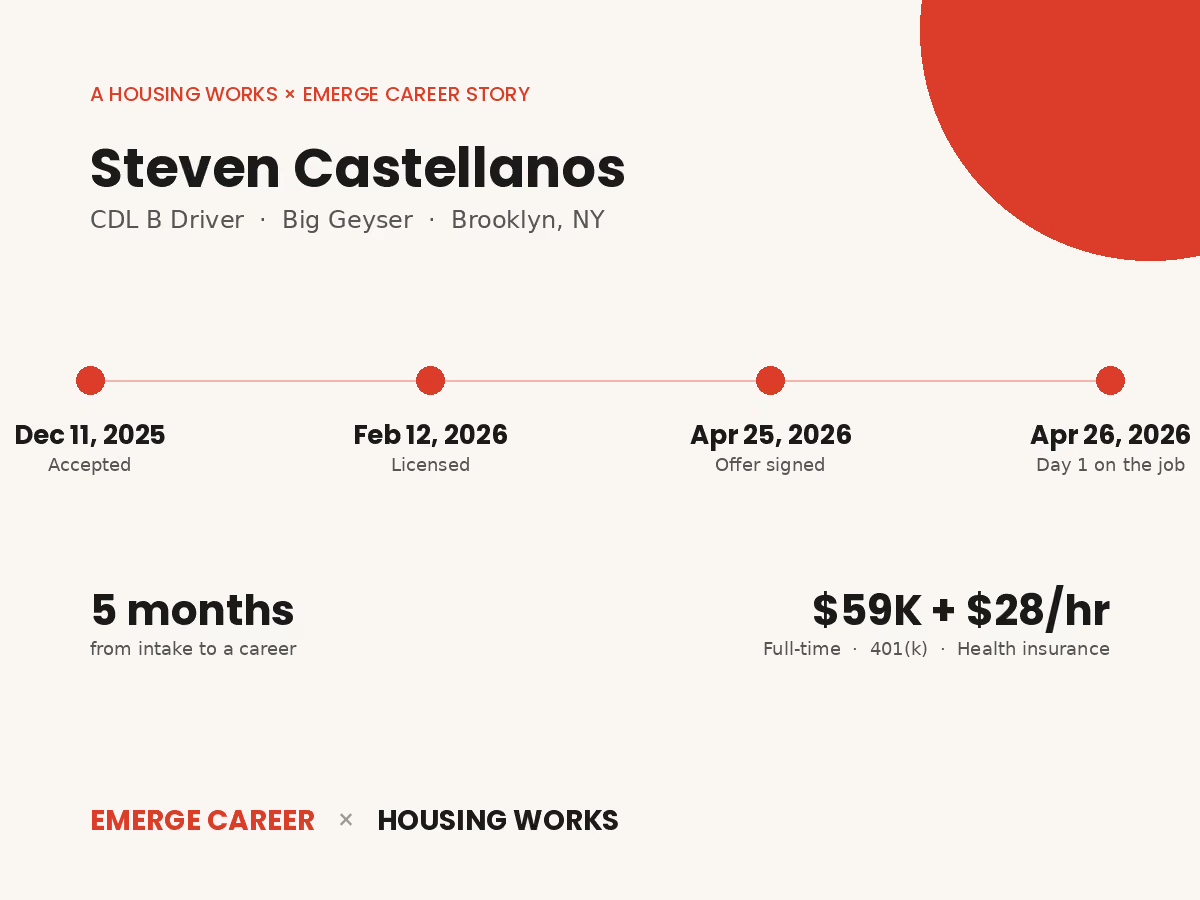
In five months, Steven Castellanos went from Housing Works intake to a full-time CDL B Driver role at Big Geyser, one of New York City's largest beverage distributors. He's earning $59,000 base plus $28/hour, with 401(k) and health insurance.
This is the story of how that happened — and why the most important part of it took place before he ever walked through our door.
Housing Works
By December 11, 2025 — the day Steven applied to our CDL program — Housing Works had already spent months building the foundation a story like this requires. Stable housing. Active healthcare. The right ID. Completion of Ready For Work, their eight-week workforce development course. A four-week internship under his belt. Trust with a system that had given him every reason to opt out.
This is the part of reentry that doesn't make press releases. It's also the part that determines whether anything that comes next is possible.
Housing Works has been doing this work in New York City for more than three decades — housing, healthcare, harm reduction, advocacy, workforce services — and they do it better than almost anyone. When Steven was referred to us, he wasn't a candidate we had to assess for readiness. He arrived ready.
At Emerge
What the next five months looked like:
- December 11, 2025 — Applied to our CDL program
- February 12, 2026 — Licensed Class A CDL through Ferrari Driving School in Brooklyn
- April 25, 2026 — Signed his offer letter with Big Geyser
- April 26, 2026 — First day on the job
Compensation: $59,000 base plus $28/hour, with 401(k) and health insurance.
Two months from license to first paycheck. Five months from intake to a career.
Our part of the work is straightforward: CDL instruction at a partner driving school, individualized success coaching, employer matching, and 30/60/90-day support post-hire. It's good work. It's also the easy part, relative to what came before it.
After Emerge
Big Geyser — the family-owned NYC distributor behind Snapple, Arizona, and most of the beverages in your bodega — doesn't hire on a maybe. When they signed Steven, they were trusting the full chain that produced him: Housing Works' readiness work, Emerge's training, and Steven's own grit.
One licensed driver, vouched for by two organizations that don't put their name on a candidate they aren't confident in.
That's the model. Housing Works prepares. Emerge trains. Employers like Big Geyser hire. Each link is only as strong as the one before it, and the one before Emerge is the one most workforce programs skip.
What's next for the Emerge Career × Housing Works partnership
Steven is the first. He won't be the last.
Over the coming months, we're scaling the referral pipeline between Housing Works and Emerge Career — moving from one-off success stories to a repeatable pathway that any Housing Works participant ready for a vocational career can step into.
What that looks like in practice: a clear referral process for Housing Works case managers, dedicated intake support on our side, and continued coordination on the wraparound services that make outcomes like Steven's possible.
If you're a Housing Works participant ready for what comes next — or a case manager with someone in mind — visit emergecareer.com or reach out directly. We're building this pipeline together, and we're just getting started.
#ReentryWorks #CDL #NewYorkCity #WorkforceDevelopment #HousingWorks
About Emerge Career
Emerge Career is a public-benefit corporation building the workforce development infrastructure that justice-impacted New Yorkers deserve. Through our partnership with the New York City Mayor's Office of Criminal Justice and our network of community-based partners — including Housing Works — we deliver Commercial Driver's License (CDL), HVAC, diesel technician, and construction trades training, with end-to-end support from intake through 30/60/90-day post-hire retention. Learn more at emergecareer.com.
About Housing Works
Housing Works is a healing community of people living with and affected by HIV/AIDS, committed to ending the dual crises of AIDS and homelessness through relentless advocacy, the provision of lifesaving services, and entrepreneurial businesses that sustain its efforts. Its workforce development programs — including Ready For Work — provide New Yorkers with the foundation for sustainable careers.
.avif)
From the Hiring Floor to the Bus Depot: How Emerge Career and the MTA Are Building a Real Pipeline
Shariza Baksh-Ramroop didn't leave our recent NYC hiring event with a stack of business cards to follow up on someday. She left with 10 resumes in hand and 5 Emerge graduates already moving through MTA's hiring process. Hear directly from Shariza in the video below — she'll tell you exactly what she came looking for, and what she found.
Three Hired. More Coming.
This moment didn't happen overnight. The MTA has already hired three Emerge Career graduates, and Shariza's decision to come back to our hiring table reflects something more than goodwill — it reflects a relationship built on results.
When she walked through the room, she wasn't browsing. She was recruiting. She reviewed 10 resumes from Emerge graduates and advanced 5 candidates directly to MTA's hiring center. That's a 50% conversion rate in a single afternoon — and a signal that our graduates are showing up prepared.
Four Candidates on the Fast Track
Of those five, four were routed straight into MTA's bus operator interview process — because they already held their CDL.
That's the pipeline working exactly the way it's supposed to. Emerge Career graduates with a commercial driver's license are walking into one of the most in-demand roles in New York City's public transportation system.The current minimum starting salary for an MTA bus operator is $26.19 per hour, rising to $37.42 by year six — with benefits that include a pension plan, comprehensive medical coverage, night and weekend differentials, and paid holidays.What makes MTA's hiring model especially powerful: they run on-site events with their exam unit and credentialing team present, enabling same-day hiring decisions. When a candidate walks in with a CDL already in hand, that timeline accelerates even further. Four of our graduates are living proof of that.
Beyond Bus Operations — A Wider Door Than Most People Think
Shariza doesn't just recruit for the driver's seat. She supports MTA's System Safety and Communications departments — and at this event, she identified strong Emerge candidates for both. That's the kind of moment that happens when a recruiter who takes the work seriously meets graduates who show up with the credentials to back it up.
She also flagged an important pathway for graduates who don't yet hold a CDL: the MTA hires through NYC's civil service track via DCAS — the Department of Citywide Administrative Services — opening additional career options beyond bus operations.The MTA relies on a wide range of people and skills across engineering, information technology, security, auto mechanics, facilities maintenance, train operations, and customer service — whether you want to serve the public, keep buses and trains in top shape, build critical infrastructure, or solve operational problems, there's a meaningful role here.That's a much wider door than most of our graduates initially realize — and we intend to walk through all of it with them.
What We're Building Next
One recruiter. One hiring event. Five candidates in motion. That's not the ceiling — that's the foundation.
Emerge Career is actively working to deepen this partnership across multiple MTA departments, expanding well beyond bus operations into skilled trades, technical roles, system safety, and communications positions.The MTA is North America's largest public transportation organization, and it's looking for dynamic individuals with a passion for public service at every stage of their careers.Our graduates — job-ready, credentialed, and motivated — are exactly that.
We're grateful to Shariza for showing up, staying engaged, and treating our graduates like the serious candidates they are. We're committed to making this partnership everything it has the potential to be.
If you're a public-sector employer, transit agency, or HR team wondering where your next pipeline of skilled, job-ready talent is coming from — let's build something together. Reach out to Emerge Career's Employer Partnerships team at [beto@emergecareer.com] to learn what a hiring event built around your roles could look like.

At Rikers Island Last Week, Emerge Turned a Skeptic into an Applicant in Fifteen Minutes. All it Took Was the Truth.
There is a version of workforce development that happens on paper, in RFPs, in job centers, in outcome reports that get filed and forgotten. And then there is what we saw last week inside Rikers Island.
This is a story about that second kind.
Through the partnership between New York City Mayor Mamdani, MOCJ Director Deanna Logan, DOC Commissioner Stanley Richards, and Emerge Career, Next Mile NYC, the City's CDL training program, if offered to people in custody at Rikers Island.
On regular basis the team at Emerge goes to Rikers to share the opportunity with eligible people in the facility and help them sign up if they're interested. We get to see what this partnership actually looks to folks awaiting their release.
Walking onto Rikers Island is not like walking into a conference room. The security process alone changes your orientation. You become acutely aware that every minute you spend in that facility matters to the people there. One of the most energizing aspects of the time we spend comes from the energy in the programs room.
Participants, people who, statistically, face enormous barriers to employment the moment they walk out, were engaged, asking great questions, joking with each other about how they'll spend their money.
One guy stuck out though.
When we first walked into the room he was in the front row. He had his arms crossed, and a look on his face that said, "idk why I'm even here." When we started the presentation, the first slide in our deck says that the average graduate makes over $85,000 starting salary. The guy in the front row looked around and almost yelled, “ whatever I can make that kinda money selling drugs though!” He almost walked out of the room.
We told him the truth: This is the fastest path to making 6 figures LEGALLY. And in a couple years he could potentially own a couple trucks and even have people working for him.
We finished explaining the steps of the program and the amazing people from Emerge who'd be working with him along his journey. By the end of the presentation he was excited about the program and was the first one to finish his application.
Here is what I think every workforce development board, every DA's office considering reentry partnerships, and every government procurement official should understand:
The "after release" model is broken.
The traditional reentry pathway asks people to prove themselves after the hardest transition of their lives: juggle family life again, find housing, manage supervision requirements, navigate benefit systems, and somehow also show up job-ready on day one. Over 60% of formerly incarcerated people remain unemployed a year after incarceration, seeking work but not finding it, and workforce development programs are severely limited inside facilities, with only one-third of incarcerated people ever participating. What Emerge and MOCJ built together combines technology-driven vocational training, personalized virtual intensive success coaching, holistic wrap-around services, stipend incentives, and direct employment placements.
The results speak for themselves: over 90% job placement rate and average starting salary of over $85,000.
The MOCJ team deserves a ton of credit for building a government partnership model that holds everyone accountable to real results. And the same goes for DOC Commissioner Stanley Richards and his team for making on-facility access possible. Real program quality requires real access, and that trust is not taken lightly.
If you're a labor agency, DA's office, public safety organization, or economic development group exploring what second-chance hiring actually looks like in the skilled trades I'd welcome a conversation! The infrastructure to make it work is already built.
What we learned at Rikers last week is that hope is still out there when folks are given real opportunities.
That's where the journey really begins.
Jason | Government Partnerships, Emerge Career

Interstate Waste Services Committed to Hiring Emerge Graduates. Here's What Built That.
Inter State Waste Services Committed to Hiring Emerge Graduates. Here's What Built That.
One employer walked out of our April hiring event with 30+ resumes in hand. A couple of weeks later, they'd already hired 2 of our graduates. Now they've formally committed to hiring at least 50.
That employer is Interstate Waste Services (IWS). And the person who made this partnership real is David Brown Sr., MBA, Director of Safety at IWS. David showed up, stayed engaged, and kept the conversation going long after the event ended. That kind of follow-through is rare. This post is about what he set in motion.
The Event Was the Setup. The Story Is What Came After.
On April 16, 2026, we ran our CDL Community Employer Hiring Event at the Brooklyn Public Library, Brooklyn Heights Branch. 48 students showed up with resumes in hand. 9 employers were in the room. By every measure, it exceeded every goal we set for it.
▶ Watch the event recap here — you'll see what the energy in that room looked like.
The centerpiece was a live four-person employer panel that gave our students an honest, ground-level look at building a career in waste services and commercial transportation:
- David Brown Sr., MBA — Director of Safety, Interstate Waste Services
- Michael J. Cristina — Director of Safety, Boro-Wide Recycling
- Zach Miller — VP of Government Affairs, Trucking Association of New York
- Leroy Smalls — Driver Trainer, Sprague Operating Resources LLC
These weren't placeholder panelists. Each one came with real information, real hiring needs, and real talk about what the work actually looks like. Our students came prepared. The employers came to recruit. That combination — when it clicks — is exactly what we built this event to create.
IWS Didn't Just Show Up. They Recruited.
David Brown and his team didn't come to wave a banner. They came to hire.
IWS collected over 30 resumes that night — more than any other employer in the room. That's a Director of Safety and his team actively working the floor: talking to graduates, asking real questions, evaluating real talent.
The results came fast:
- ✅ 2 graduates hired directly from the event
- 🔄 More interviews actively in progress
- 📋 Formal commitment: IWS will hire at least 50 Emerge Career graduates from our program
Don't take my word for it — hear it directly from David himself:
▶ "We Need Many Drivers" — David Brown, Director of Safety, Interstate Waste Services
David says it plainly: IWS needs drivers. A lot of them. And they've decided Emerge graduates are who they want filling that pipeline. That's not a polite gesture — that's a hiring commitment backed by action already underway.
The Pathway: CDL Driver Helper → Full CDL Driver
Here's what makes this more than a job fair win. IWS isn't just handing our graduates a job and calling it done. They've structured a real career track.
Our graduates enter IWS as CDL Licensed Driver Helpers — working alongside experienced drivers, learning the operation from the ground up: the routes, the physical demands, the safety standards, the culture. This is intentional onboarding, not a holding pattern.
The pathway:
- CDL Licensed Driver Helper — ride the routes, learn the company, prove reliability
- Promotion to Full CDL Driver — with IWS directly or through their network of partner companies
- Continue growing — IWS has a deep culture of promoting from within; their supervisors, managers, and dispatchers have been doing this for yearsMany of IWS's supervisors, managers, and other leadership staff started their careers as helpers, drivers, or dispatchers — and they are eager to promote from within.What's new is that Emerge Career is now a formal feeder into that pipeline — and IWS is backing that with a committed hiring number and graduates who are already on the job.
This isn't a gap-filler role. It's a launchpad.
A Genuine Thank You to David Brown and the IWS Team
Big-picture partnerships don't build themselves. They build because one person decides to show up, stay in it, and follow through after everyone else has gone home.
That person is David Brown Sr., MBA. David came to the panel, he engaged authentically with our students, and when the event was over, he kept the conversation going. He's the reason IWS has already made two hires, has interviews in progress, and has committed to 50 more. He's the champion here — and Emerge Career does not take that lightly.
To David and the full IWS team: thank you. You're not just hiring graduates. You're helping build what this entire program is designed to produce — a real, functioning pipeline from our community into careers in the trades. That matters more than you know.
What This Means If You're Building in This Space
A few things became clear through this process that I want to put on the record:
- Employers are hungry. IWS collected 30+ resumes in one night because the need is genuine.IWS is one of the most progressive and innovative providers of solid waste and recycling services in the country, and they still can't fill their driver seats fast enough. The CDL shortage is not abstract — it shows up as a Director of Safety personally working a hiring event floor.
- Structure beats intention. The Helper-to-Driver pathway works because it's a defined career track, not a vague "opportunity to grow." Our graduates know what Day 1 looks like and what promotion looks like. That clarity is what makes placements stick.
- One champion changes everything. David Brown didn't have to commit to 50 hires. He did it because he sees what Emerge graduates bring. If you're an employer reading this — be the David Brown at your company.
Partner With Emerge Career
If you're in waste services, trucking, HVAC, EV tech, or any skilled trade where you need a pipeline of trained, job-ready CDL talent — let's talk. We're actively building employer partnerships across the New York metro area and beyond.
.avif)
From Zero Experience to Job-Ready: How Emerge's HVAC Program Is Closing the Skilled Trades Gap
From Zero Experience to Job-Ready: How Emerge Career's HVAC Program Is Closing the Skilled Trades Gap
.avif)
Meet Charles R.
Charles is a student in Emerge's recent HVAC cohort. Even before graduating, he already has a job offer from Cornerstone Services, where he's been clocking in as an HVAC apprentice — showing up to job sites, doing real work, earning real money.
We're still in the program. And Charles is already on the other side. That doesn't happen by accident.
The HVAC Skilled Trades Gap Is Real
If you work in facilities, construction, property management, or any industry where you need buildings to stay cool in the summer and warm in the winter, you already know this: there aren't enough HVAC technicians. Not even close.
The country is short hundreds of thousands of skilled trades workers — and HVAC is one of the hardest-hit fields. Companies are sitting on open requisitions they can't fill. Job sites are backing up. And most of the workforce pipeline programs out there aren't built to move fast enough or reach the people who need them most.
That's exactly where Emerge comes in.
The Emerge Career HVAC Training Program
Our HVAC Technician Program is an eight-week hybrid training experience. Students start with theory — the fundamentals: refrigeration cycles, heating systems, air conditioning, heat pumps, ductless mini splits, series and parallel circuits. Then they dig in hands-on: into real units, real wiring, real equipment. Students also receive 1-on-1 coaching and job readiness workshops to help them land their first HVAC job.
By the time students finish, they're walking out with two industry-recognized credentials: the EPA 608 certification and OSHA 10. Those aren't participation trophies. Those are the actual tickets to getting hired in this field.
Watch the video below to see our first cohort in action 👇
A Second Opportunity in Life
Every single person in this program has had a harder road to get here than most. These individuals come from a variety of underserved backgrounds and face barriers to employment. Each participant has navigated challenging times in the past and is actively choosing a different direction. Not because it's easy. Because they believe there's something on the other side worth working toward.
"A second opportunity in life to me means giving me another chance — changing my whole career path and giving myself a second chance, believing in myself that there's another opportunity out there for me to overcome my obstacles and goals."
That's not somebody who's going to take a job offer lightly. That's somebody who is going to show up.
Another student described what it feels like to walk into a job interview now versus before: "I definitely feel like I'm going in there with an edge, which makes me happy — because you always want to have something to present in these situations when you're looking for jobs."
That edge is real. And employers are noticing it.
The program hasn't finished, but here are some outcomes so far:
- Many students have received employment offers
- Employment offers from Cornerstone Services, Home Depot, Roto-Rooter
- Students are already starting work as HVAC apprentices
- Starting wages ranging from $25 to $50 per hour.
Why This Matters to Employers
HVAC is a field where demand isn't going anywhere. The housing stock is aging. Climate demands are intensifying. Refrigerant regulations are changing. Employers need technicians who understand not just the mechanical side, but the safety and regulatory landscape too.
Our students get that. One student talked about what the EPA 608 certification opened up for him: "It gave me a broad understanding about how it affects us completely — it has a very big effect on the ozone and the climate." And on OSHA 10: "It's helped me understand that my safety is on the line, as well as other people's. Everybody's affected."
If you're an employer in the HVAC space who wants early access to our next group of trained, credentialed graduates — let's talk. And if you're a workforce development partner or government agency looking for a program that actually delivers outcomes, not just completions — we'd love to connect.
"Knowing that Emerge has taken their time, believed in us, and given us the tools and the education to get through a trade like this — that's what made me believe in myself."
→ Learn more or partner with us at EmergeCareer.com📧 sales@emergecareer.com

At MDC Brooklyn, Emerge Career Showed Why We’re the Best Option for Justice-Involved Workforce Development
Every year, 600,000 people walk out of state and federal prisons in the United States, but most of them walk into nothing. No job lined up, no credential in hand and a sky-high unemployment rate waiting on the other side of the gate.
Last week, I visited the Metropolitan Detention Center in Brooklyn. You may know it as the facility that's held Sean "Diddy" Combs, Luigi Mangione, Ghislaine Maxwell, and most recently, Nicolás Maduro. I was there the same day as the Knicks championship parade. Rather than celebrating with my adopted team, who had just won their first title in 53 years, I was inside a federal detention center talking with people who are currently incarcerated.
I went to talk about what Emerge Career does. What I found instead was a room full of people who already knew, and were eager to sign up.
The room was packed with each new wave of interested participants, and our table saw the highest level of engagement of any participating organization.
Program directors. Reentry coordinators. Community-based organizations. Correctional officers. Probation staff. Everyone who touches the system from a different angle was in that room, and every one of them was excited to hear about our work.
That kind of near-universal enthusiasm is what happens when the people closest to the system recognize that a real solution is sitting right in front of them for most of the problems faced by the people shuffling around in jumpsuits.
To me it showed that even those who work closest to the system don't really want to hold it up as our best effort to rehabilitate people and deliver public safety. They know the cycle. They see it repeat, and they're looking for a better answer.
The consensus in that room was clear: a great job is a better approach than endless cycles of incarceration.
I left MDC Brooklyn with about 30 requested sign-ups and a request to provide in-custody training for residents.
Many of the individuals I met don't have a release date for over a year but that didn’t deter them from excitedly planning for the day when they can enroll and get on the path to a six-figure salary in the skilled trades. When they heard what our graduates are earning, which is regularly confirmed by friends inside the facilities, they wanted to be next in line.
But this wasn't a room full of people waiting to be saved. Every person I met had plans. They were doing research from inside a federal facility, building toward something specific, like a new small business, starting a family, and embarking on a new career journey.
Our NYC program with the Mayor's Office of Criminal Justice has trained and placed hundreds of participants into skilled trades careers where starting salaries range from $65,000 to $124,000 and the average is close to $75,000. Our participants succeed at rates 50% higher than national averages and earn nearly twice as much as the typical workforce program graduate.
For a population that faces 60% unemployment post-incarceration, those numbers aren't just good. They're game changing. They’re “reorient my every routine and lifestyle” numbers.
The conventional wisdom is that reentry workforce programs are feel-good investments with marginal returns. The data says otherwise.
RAND Corporation research shows that 5-year recidivism, which nationally hovers around 70%, drops to 50% when someone completes some high school while incarcerated. An associate degree brings it to 13.7%. A bachelor's brings it to 5.6%. A master's degree: 0%.
Vocational credentials tell a similar story. Research shows the hazard of recidivism is substantially lower when former inmates are employed, compared with their unemployed peers. Across Emerge Career graduates, our reported rearrests are near 0% 2 years after completing the program.
Emerge's 90+% credential attainment rate and 95+% job placement rate show we're setting a new standard in workforce development. What's more, our average salary of nearly $75,000 nearly doubles the outcomes of even the best state workforce boards.
The difference is embedded in our programmatic design. We offer success coaching with daily check-ins for at-risk students and wrap-around service referrals that address the real barriers (fines, fees, transportation, housing instability, etc.). Most importantly, our direct employer partnerships turn training into job offers, not job searches and endless months waiting for an offer.
We are building Emerge Career to close the gap between incarceration and employment. Rather than hope someone else would solve this systemic problem we are building the infrastructure. Our technology-driven training, world-class coaching, employer partnerships, and demonstrable outcomes show our ability to back up our vision.
MDC Brooklyn showed that the demand for this model has outpaced our ability to supply it and we need to continue pushing for additional expansions with our ecosystem partners. People in facilities across the country are publicizing our value before we even make the pitch, the staff in every facility we speak with want to offer something better, and people sign up on the spot to prove it.
600,000 people will be released from a corrections facility this year. The question isn't whether they want to work. It's whether we're ready for them.
Jason Barefoot is Head of Government Accounts at Emerge Career, a Y Combinator-backed reentry workforce platform operating in New York, California, Massachusetts, and Colorado. To learn more or partner with us, visit emergecareer.com.
%2010.jpeg)
Q1 2026 Recap: 24 Community Events Across All Five Boroughs in 10 Weeks
24 Events. 5 Boroughs. 10 Weeks.
Between late January and early April 2026, Emerge Career conducted 24 community events across every borough in New York City — an average of more than two events per week. These weren't webinars or email blasts. They were real, in-person sessions in libraries, community centers, reentry organizations, and a federal probation office — staffed by Emerge's team, accompanied by food, and designed to do one thing: get justice-impacted New Yorkers closer to high-paying CDL careers.


The Numbers
| Borough | Events | Key Locations |
|---|---|---|
| Harlem / East Harlem | 7 | WeWork 126th St, Exodus Transitional Community |
| Brooklyn | 6 | Brooklyn Heights Library, BKPL Central, Neighbors in Action (Bedstuy), Brownsville |
| Bronx | 6 | 111 Bruckner Blvd (Bronx HYPE / REM Center), BOGAP, EmpowerHer Job Fair |
| Queens | 4 | Queens Public Library, Ravenswood Community Learning Center (LIC) |
| Lower Manhattan | 1 | U.S. Federal Probation Office, Southern District (200 Worth St) |
Three Event Formats
Study Halls were the backbone of the quarter — recurring weekly sessions at public libraries and community spaces where enrolled participants prepped for the Commercial Learner's Permit (CLP) exam with hands-on coaching. By the end of the quarter, the Harlem study hall series posted an 85% permit attainment rate, and the Bronx series hit 83%.
Activation & Info Sessions combined recruitment and engagement — introducing the Next Mile NYC program to new audiences in the neighborhoods where they live, then transitioning into study hall mode for those already enrolled.
Partner Recruitment Events embedded Emerge directly within established reentry and workforce organizations — including Exodus Transitional Community, Neighbors in Action, BOGAP, and the EmpowerHer Job Fair — giving the team direct access to justice-involved individuals already engaged with trusted community institutions.
Why In-Person Events Matter
Emerge Career is a technology company. The training platform is online. The learning hub works on a phone. But the events are in-person — and that's intentional.
Most people navigating reentry don't find workforce programs through Google. They hear about them from a case manager, a parole officer, a friend, or a community organization they already trust. In-person events create the trust that digital outreach alone can't. When someone walks into a study hall and sees a dozen other people in the same situation, actively studying for an exam that leads to a $80,000+ career — that's more convincing than any ad.
Every event was staffed by Emerge's team. Every event had food. And every event was designed to remove friction: no sign-up fees, no prerequisites, no gatekeeping. Just show up.
The Full Q1 Event Calendar
| Date | Event | Location | Type |
|---|---|---|---|
| Jan 29 | Brooklyn Meet & Greet | Brooklyn Heights Library | Activation |
| Feb 5 | Harlem Study Hall #1 | WeWork, 126th St | Permit Prep |
| Feb 12 | Harlem Study Hall #2 | WeWork, 126th St | Permit Prep |
| Feb 20 | Brooklyn Public Library Study Hall | BKPL Central Branch | Permit Prep |
| Feb 25 | Neighbors in Action Study Hall | Bedstuy, Brooklyn | Recruitment + Permit Prep |
| Feb 26 | Queens Public Library Study Hall | Queens Public Library | Permit Prep |
| Mar 5 | South Bronx Study Hall | 111 Bruckner Blvd, Mott Haven | Permit Prep |
| Mar 10 | Queens Info Session & Study Hall | Ravenswood, LIC | Activation + Permit Prep |
| Mar 13 | Brooklyn Study Hall (Brownsville) | 519 Rockaway Ave | Activation + Permit Prep |
| Mar 17 | Federal Probation Partnership | 200 Worth St, Lower Manhattan | Recruitment |
| Mar 17 | South Bronx Study Hall | 111 Bruckner Blvd | Activation + Permit Prep |
| Mar 18 | Bedstuy (NIA) Study Hall #2 | 1406 Fulton St, Brooklyn | Activation + Permit Prep |
| Mar 19 | BOGAP Info Session | 809 Westchester Ave, Bronx | Recruitment |
| Mar 19 | Harlem Study Hall | 8 W 126th St | Activation + Permit Prep |
| Mar 20 | Exodus Lunch & Learn | 2268 3rd Ave, East Harlem | Recruitment |
| Mar 24 | Queens Study Hall (LIC) | Ravenswood, LIC | Activation + Permit Prep |
| Mar 24 | Bronx Study Hall | 111 Bruckner Blvd | Activation + Permit Prep |
| Mar 25 | Harlem Study Hall | 2268 3rd Ave, East Harlem | Activation + Permit Prep |
| Mar 26 | EmpowerHer Job Fair | 851 Grand Concourse, Bronx | Recruitment |
| Mar 31 | Bronx Study Hall (83% attainment) | 111 Bruckner Blvd | Activation + Permit Prep |
| Mar 31 | Queens Study Hall (LIC) | Ravenswood, LIC | Activation + Permit Prep |
| Mar 31 | Harlem Study Hall | 2268 3rd Ave | Activation + Permit Prep |
| Apr 1 | Brooklyn Study Hall (67% attainment) | 1958 Fulton St, Bedstuy | Activation + Permit Prep |
| Apr 2 | Harlem Study Hall (85% attainment) | 8 W 126th St, Harlem | Activation + Permit Prep |
Community Partners
None of this works without the organizations that opened their doors, made referrals, and vouched for the program: Neighbors in Action (CJI), Exodus Transitional Community, BOGAP, Bronx HYPE / REM Center / Family Empowerment Center, Brooklyn Public Library, Queens Public Library, Ravenswood Community Learning Center, U.S. Federal Probation Office (Southern District of New York), and the EmpowerHer Job Fair.
What's Next
Q2 programming is already underway. On April 16th, Emerge Career and Next Mile NYC are hosting a CDL Employer Hiring Event at the Brooklyn Public Library — a structured hiring event where trained CDL drivers can sit across from companies that are actively hiring. On-site interviews are on the table.
If you're in New York City, you've been impacted by the justice system, and you want a career that pays $75,000 to $125,000 a year — the door is open.

How To Redefine Trades Education: Inclusivity, Innovation And Impact

A recent graduate of our vocational program had long dreamed of becoming a driver. Time and time again, she had been turned away—no school would admit her. Without a high school diploma, no financial aid program was available to her. Despite this, her resilience never faltered, and she eventually succeeded and got a job driving an 18-wheeler.
This story is all too common: Across the nation, millions of Americans are seeking pathways out of the suffocating clutches of poverty. At first, I struggled to reconcile how billions of government dollars were being funneled to upskill low-income individuals, yet alternative skilled trade programs often missed the mark.
Over time, I've come to realize systemic flaws contributing to this failure and the urgent need to redefine trade programs to genuinely serve those who need it most.
The Surge In Vocational Training
The long-held belief that a college education is the pathway to upward mobility remains elusive for most Americans, particularly the 37 million living in poverty. A staggering 44% of students do not finish their college programs, with two-thirds hailing from low-income backgrounds.
As an increasing number of individuals question the economic worth of a degree in the face of a student debt crisis surpassing a trillion dollars, more people are exploring alternatives. In response, trades programs have emerged as practical solutions, providing faster completion times, often in just a few months, and being significantly more affordable.
With this evolving landscape, the traditional trades education model faces the imperative to innovate and meet the surging demand. There's a pressing need to bolster recruitment, reshape public perceptions of trades, ensure comprehensive support, streamline funding processes, personalize success strategies and reinforce alumni networks.
Paving The Path Forward: Reinventing The Trades For Marginalized Communities
To modernize and make trades education more inclusive, the following key pillars need attention.
1. Grassroots Recruitment: Modern colleges have been locked in an advertising arms race, spending billions to garner attention. However, trades should opt for a more authentic approach: grassroots recruitment.
By partnering with community-based organizations, they can ensure that opportunities are channeled to the right individuals. Many potential candidates, often sidelined in traditional systems, are unaware of how trades could change their life trajectories.
2. Rebranding: Trades have suffered unjust stigma for too long. Outdated notions portray them as inferior to white-collar jobs, but reality contradicts this misconception. Trades go beyond manual labor; they power our economy, tackle real-world problems and provide deeply fulfilling careers.
The pandemic spotlighted the heroic status of nurses. Few are aware that the average Class A truck driver can earn more than the average college graduate. There are compelling reasons to revamp the image of trades and break free from the shackles of stigma.
3. Individualized Support: The actual training is only half the equation. For trades to truly uplift individuals from marginalized backgrounds, we must look beyond the classroom, offering a comprehensive support system. This involves wraparound services that cater to challenges, both academic and personal, that these individuals face daily. By appointing dedicated coaches trained in culturally responsive trauma-informed practices, we can ensure every student feels seen, heard and supported.
4. Easier Access To Government Funding: Financial constraints shouldn't deter anyone from pursuing their aspiration. While the U.S. earmarks billions of funds for vocational training annually, bureaucratic mazes often put these resources beyond many people's grasp. Academic literature has repeatedly shown the positive effect of transparent processes and guided assistance in benefits enrollment.
This is an area where technological innovation can fundamentally change the status quo at scale. By reviewing individuals' documents and analyzing the self-reported demographic data, we can effortlessly navigate the paperwork, match individuals with suitable funding and present this through a modern, intuitive interface.
Carefully researched design ensures that these platforms can be navigated even by those with minimal digital proficiency, widening the reach of vocational training opportunities.
5. Technology-Powered Training: Technology holds the transformative power to customize education like never before. Imagine a system where students are not just another number, but where each receives an individualized success plan tailored to their unique needs, rather than being funneled through a one-size-fits-all approach, especially for licensing processes that rely heavily on rote learning.
With technological advancements, not only can learning plans be personalized and diagnostic tests be adjusted to fit individual requirements, but a macro view can also be maintained. Such integrated monitoring systems enable instructors and government agencies to track and evaluate cohorts' progress, ensuring that every student receives the tailored guidance and support they need to flourish.
6. Alumni Community: The strength of any educational initiative isn't just in its curriculum but in its community. While universities have long thrived on robust alumni networks, trades have traditionally lagged in this regard. By establishing a transparent alumni community platform where individuals can seamlessly connect based on their shared interests, trade schools can promote mentorship, facilitate job opportunities and nurture a culture of continuous learning and giving back.
In a changing world, the educational model for trades must evolve. The story at the outset of this article, like countless others, highlights the urgency of this transformation. We've seen individuals' unwavering determination to escape poverty, often hindered by an inadequate system.
As we stand at this crossroads, we must recognize that this is our chance to empower marginalized communities to rewrite their narratives and build a world where the pursuit of meaningful, well-paying careers knows no barriers. Together, we can pave the path forward, reinventing the trades to uplift those who need it most, ensuring that the promise of a brighter future becomes a reality for all.
To see the original article, click here.

Emerging From Incarceration: The Future Of Reentry
Luis was one of the first justice-involved students we served in California. When he joined our Commercial Driver training program, he had just left an $18/hour job at a waste disposal company. He had inhaled so many toxic fumes that he was placed on temporary medical leave. He was desperately looking for a way out. Luis's story is unfortunately not unique, and it shares similarities with the reality of millions of Americans. The toll of mass incarceration cannot be understated: with 2.3 million individuals currently incarcerated, 600,000 cycling in and out of jail every year, and 70 million living with arrest or conviction records. 95% of these individuals will eventually rejoin our communities. They will become our neighbors, coworkers and fellow citizens, shaping the future of our shared environment. Yet, despite this potential for transformation, our country is failing them in a critical regard. A staggering 60% of the justice-involved population remains without work, while 27% struggle with unemployment. These aren't just faceless numbers—they embody real lives, individuals who deserve the chance to rise above their pasts and forge new paths forward. Faced with these pressing realities, the urgency to redefine reentry strategies has never been more palpable.
The Justice-Involved Are Excluded From The Workforce
With unemployment rates surpassing those of the Great Recession, the urgency to equip individuals for reintegration into the workforce is undeniable. Over 80% of incarcerated people enter incarceration with no pre-incarceration earnings, making vocational readiness a paramount goal of any reentry model. Yet, the existing framework falls woefully short. Job training opportunities are severely limited, with only one-third of incarcerated people ever participating. The available prison jobs offer meager wages, often less than $1 per hour, further entrenching the cycle of poverty. The vast majority of re-entrants are under the age of 55, at the peak of their productive years, but upon release, many face a bleak reality, armed with nothing more than a bus voucher, a nominal release check, and the daunting challenge of rebuilding their lives. These disheartening statistics underscore the imperative to overhaul the reentry system, investing in comprehensive programs that equip individuals with the tools necessary for post-incarceration success.
The Evolution of the Reentry Model
The future of the reentry model is built on four essential pillars.
1. More Job Opportunities
First, central to the new paradigm is the expansion of vocational training opportunities. This begins with strategic pre-release vocational preparation that serves as a cornerstone for success. Across the country, various skilled trades are grappling with labor shortages, prompting desperate employer searches for new hires. Many of these trades don't demand high educational attainment for entry-level positions; however, they offer wages that elevate individuals well above the poverty line. Numerous vocations present ample training opportunities before release—whether it's aiding individuals in grasping vocational demands, acquiring essential career readiness skills, rebuilding resumes, or gaining digital literacy skills that bolster job performance and life capabilities. If individuals are afforded a head start, along with a clear comprehension of how their chosen vocation can evolve into a career, and a solid plan in hand.
2. Tech-Driven Reentry
Second, the integration of technology is pivotal in empowering reentry initiatives and expanding their reach. The Michigan Vocational Village serves as a prominent example of a successful prison-to-employment program across the country. While its results are impressive, its capacity is limited, accommodating only 165 vocational trade students. Correctional facilities have inherent spatial constraints, hindering scalability. However, technology presents an opportunity for exponential growth. The advent of the COVID-19 pandemic expedited the integration of technology within the corrections system, creating an opportune moment to embrace technology as a fundamental element in reenvisioning reentry planning. Technology can effectively deliver educational training, empower correctional and government personnel to oversee programs and provide tailored educational support based on individual student journeys.
3. Empowering the Movement
Third, the adage "it takes a village" holds, particularly in reentry contexts. Often, we come across nominal partnerships listed on correctional department websites. Yet, by harnessing pre-release information, we can dynamically link individuals with the right Community-Based Organizations (CBOs), forging a collaborative network that caters to their unique needs as they embark on the reentry journey. This extends beyond organizational collaboration, encompassing an array of wraparound services that address re-entrants' attitudes and beliefs about crime, mental health issues, mentorship, education, job training, and connections with community resources. These wraparound services form a strong foundation, serving as protective factors.
4. Data-Driven Reentry
Fourth, the integration of technology into the future of re-entry brings data to the forefront of the discussion of effective programming. Currently, disjointed endeavors across government agencies culminate in isolated information pockets and redundant processes, exacerbating challenges for individuals seeking essential services. Furthermore, this decentralization exacerbates the lack of comprehensive insights, a longstanding predicament in the criminal justice sector that hampers informed policy-making. The evolution of reentry programming introduces transparency as multiple agencies and organizations intersect with reentrants. This transparency lays the foundation for collaborative synergy among stakeholders, working collectively to empower reentrants on their journey toward a fresh start.
In the journey to reform reentry, we need to recognize that our mission is not solely about overhauling systems; it's about transforming lives. Through the pillars of vocational empowerment, technology integration, and collaborative networks, we're crafting a path of opportunity, growth, and redemption. We're not just reimagining the framework; we're igniting hope and possibility. As we press forward, we cannot forget that the statistics we aim to change are reflections of real stories, and the impact of these discussions reaches far beyond policy adjustments. By championing reentry, we're championing individuals like Luis, giving them the chance they deserve to rise, thrive, and make a positive mark on the world.
This article was originally published on Forbes and can be seen here.
Emerge Career Launches Monthly Partner Roundtable — And the Response Was Electric
Published: April 2026
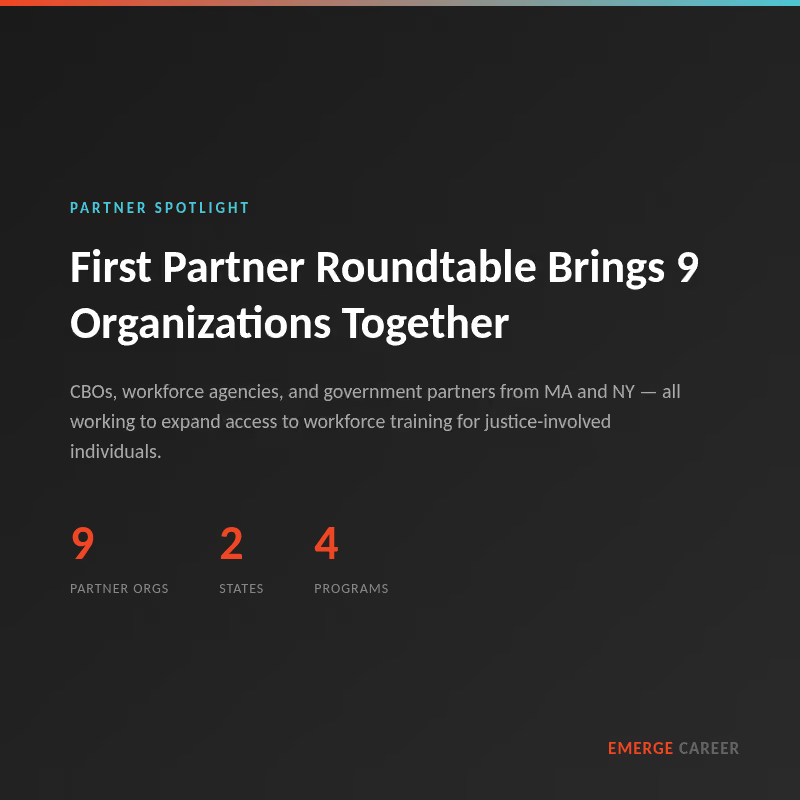
Nine community organizations across Massachusetts and New York joined our first-ever CBO Partner Roundtable — and the conversation made one thing clear: the demand for workforce training built around justice-involved individuals is only growing.
On April 16, Emerge Career hosted its inaugural Partner Roundtable — a monthly virtual convening designed to bring together the community-based organizations, government agencies, and workforce partners who refer participants to our training programs.
The goal was simple: get everyone in the same room, share what's new, and make it easier for our partners to connect their clients to opportunity. What happened exceeded expectations.
Who Showed Up
Nine organizations joined from across two states, representing probation departments, reentry programs, youth services, substance use recovery, and workforce development:
- NYC Department of Probation / Neighborhood Opportunity Network (NEON) — New York City
- America Works — New York (national)
- Housing Works Justice Initiative — New York City
- Neighbors in Action / Center for Justice Innovation — New York City
- Mayor's Office of Returning Citizens — City of Boston
- Legendary Legacies — Worcester, MA
- Worcester Youth Center — Worcester, MA
- Institute for Health and Recovery, ATR Program — Boston, Lowell, and Springfield, MA
That's a room full of people doing the hard, daily work of meeting justice-involved individuals where they are — and helping them build something new.
What We Heard
Three themes came through loud and clear.
1. The demand for trades training goes way beyond CDL.
Nearly every partner on the call asked the same question: When are HVAC and diesel tech coming to my area? Our CDL program has been the foundation, but partners are telling us their clients want more options — especially participants who face barriers to obtaining a commercial driver's license. We're actively pursuing funding to bring additional vocations to both Massachusetts and New York, and the roundtable reinforced just how urgent that expansion is.
2. Proximity matters.
Our Boston-area partners were candid: the distance to our current Western Massachusetts training sites is a real barrier for their clients. We heard them. Finding the right space for a Boston-area training center is a top priority, and we're actively exploring locations and funding partnerships to make it happen. The same goes for New York City, where we're working toward a training center within the five boroughs.
3. This network is stronger than any single organization.
The most energizing part of the roundtable wasn't the updates from Emerge — it was hearing partners learn about each other. Organizations serving probation populations discovered peers working in substance use recovery. Youth-focused programs connected with city agencies doing employer engagement. The roundtable created space for cross-referrals and collaboration that wouldn't have happened otherwise.
Program Updates We Shared
We used the roundtable to spotlight two of our newest programs:
HVAC — Our existing HVAC program is enrolling now in Massachusetts, covering EPA 608 certification, split system installation, furnace diagnostics, refrigeration, and controls. We're actively pursuing funding for a dedicated training site that would allow us to scale capacity significantly.
Diesel Technician — We're on track to register one of Massachusetts' first Diesel Technician Registered Apprenticeship Programs. The structure is a three-year, 6,000-hour program with Emerge delivering the first-year pre-apprenticeship and an employer sponsor providing on-the-job training for years two and three. Pre-apprenticeship referrals are open now.
What Comes Next
The Partner Roundtable is now a monthly fixture — every third Thursday at 2:00 PM ET. Our next session is May 21, 2026.
We also sent every attending organization a formal partnership agreement (MOA) to make it easier to collaborate on referrals and joint funding applications. When our partners are stronger, our participants get better outcomes. That's the whole point.
If your organization serves justice-involved individuals and you're interested in joining the roundtable or learning more about referring clients to our programs, reach out to us at elizabeth@emergecareer.com.
Emerge Career is a Public Benefit Corporation providing workforce training — CDL, HVAC, Diesel Technician, and Construction Trades — primarily for justice-involved individuals. We operate in Massachusetts, New York, California, and Colorado with over $13 million in active contracts.
Thank you! Your submission has been received!
Case Studies.
AI-proof careers in industries with critical labor shortages.
This is a “win-win.” Many formerly incarcerated individuals have trouble finding work upon release, which can drive them back into crime.
.avif)
The data is also showing us that our investments in Emerge Career are paying immense dividends, in real second chances and wealth creation for some of our city’s most disadvantaged communities.
.avif)