CDL Requirements
What it takes to qualify for a Class A CDL: the commercial learner's permit, the DOT physical, the written and road tests, and what can put you on hold.
How Much Does CDL Training Cost? The Real Price Breakdown for 2026
Most CDL training programs cost between $3,000 and $10,000 out of pocket. Some cost nothing. The difference depends on who's paying, what strings are attached, and whether you know where to look. This guide breaks down every option so you can compare them honestly.
The short answer
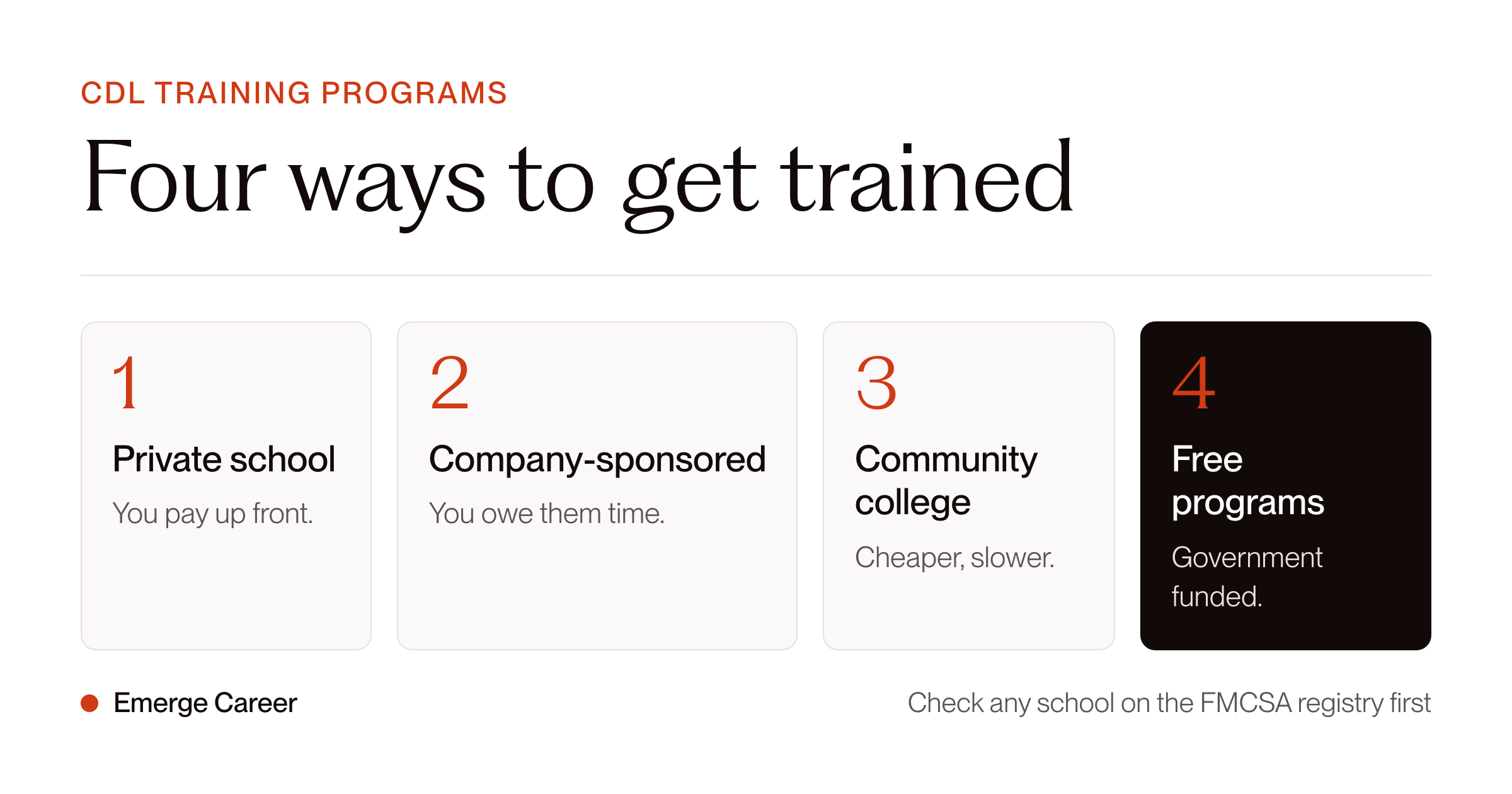
A Class A CDL will run you $3,000 to $10,000 at a private school. Community colleges charge less, usually $1,500 to $5,000. Company-sponsored programs cost $0 upfront but come with contracts. And government-funded programs, like the one we run at Emerge Career, are free with no contract, no payback, no catch.
That range is wide enough to be useless on its own. So here's what actually matters: what you're paying for, what you're giving up, and what you're getting in return.
Option 1: Government-funded programs ($0)
Programs funded by city, state, or federal agencies cover the full cost of CDL training for eligible participants. No tuition. No repayment. No employment contract.
Emerge Career is one of these. We're funded by the NYC Mayor's Office of Criminal Justice and train students for a Class A CDL at zero cost. That includes permit prep, skills training, DOT physicals, and job placement support. Graduates land jobs averaging $77K in annual salary.
Similar programs exist through WIOA (Workforce Innovation and Opportunity Act), which funds CDL training through local American Job Centers in every state. If you're unemployed, underemployed, or recently laid off, WIOA can cover 100% of tuition, testing fees, and sometimes even your DOT physical. It's a grant, not a loan. You don't pay it back.
The catch with most government-funded programs is availability. WIOA funding depends on your local workforce board. Some regions have long waitlists. Others don't list CDL training on their approved provider list. You have to call your local American Job Center and ask.
Programs like Emerge are even more specific. Ours serves people with justice involvement in New York City. Other cities and states run similar programs, but they're not everywhere yet.
Who this works for: Anyone eligible. If you qualify for a free program, take it. You get trained, you owe nothing, and you pick your employer.
Option 2: Community college CDL programs ($1,500 to $5,000)
Community colleges offer the second-cheapest path. In-state tuition for a Class A program typically falls between $1,500 and $3,500, though some run higher depending on the state. They're accredited, which means you can use financial aid (Pell Grants, WIOA vouchers) to offset or eliminate costs.
Community college programs tend to run longer (8 to 16 weeks vs. 3 to 4 at a private school). That slower pace means more seat time behind the wheel. Most public programs train on manual transmissions, which gives you an unrestricted license. That matters. An automatic-only restriction limits which carriers will hire you.
The downsides: waitlists. Popular programs fill up months in advance. Start dates are fixed to the academic calendar. And the scheduling is less flexible than a private school.
Who this works for: People who have time, want to keep costs low, and don't mind waiting for a seat.
Option 3: Private CDL schools ($3,000 to $10,000)
Private schools are the fastest route. Most programs run 3 to 8 weeks. You pick a start date, show up, train, and test. Class A programs cluster around $4,000 to $7,000, with some in high-cost markets (California, the Northeast) reaching $10,000.
The speed is the selling point. If you need a CDL fast and can pay upfront, private schools get you there. Many also partner with carriers for tuition reimbursement after graduation, which brings the effective cost down.
Quality varies. A lot. Some private schools pack classrooms and limit your actual driving time. Others run small cohorts with strong instructor ratios. Before you sign up, ask three questions: How many hours of behind-the-wheel time will I get? What's the student-to-instructor ratio? And do you train on manual or automatic?
Who this works for: People who can pay (or finance) upfront and want speed. Best when paired with a tuition reimbursement deal from a carrier.
Option 4: Company-sponsored training ($0 upfront, but read the contract)
Large trucking carriers like Swift, Werner, CRST, and C.R. England may offer CDL training at no upfront cost. They cover tuition, sometimes housing and meals, and guarantee you a job at graduation.
In exchange, you sign a contract. Typically 12 to 24 months. If you leave before the contract ends, you owe the full or prorated training cost. That repayment can run several thousand dollars. Some contracts include interest. Some carriers report contract breaches to DAC (the trucking industry's background check database), which can follow you to future employers.
The other cost is less visible. Company-sponsored drivers typically start at lower pay rates than graduates who trained independently. Over a full year, that gap can add up to tens of thousands in lost earnings. The training is "free" on paper, but you pay for it through reduced wages and restricted job mobility.
This isn't a scam. For someone with no savings, no access to WIOA, and no other way in, company-sponsored training is a real path into the industry. But you should read the contract line by line. Know the repayment terms. Know the minimum pay. Know what happens if you get hurt, get fired, or just can't stand the job.
Who this works for: People who have no other funding option and are comfortable committing to one carrier for a year or more.
The costs nobody talks about
Tuition is the headline number, but it's not the only number. Budget for these regardless of which path you choose:
- DOT physical: $75 to $150 (required before you can get your permit)
- Drug screening: $30 to $100
- Commercial Learner's Permit (CLP): $10 to $100 depending on the state
- CDL skills test fee: $50 to $250
- CDL license issuance: $20 to $120
- Endorsements (HazMat, tanker, doubles/triples): $5 to $100 per endorsement, plus possible background check fees
Total for fees alone: somewhere between $200 and $700 for most people.
Some programs bundle these into tuition. Some don't. Ask before you enroll.
How to figure out which option is available to you
Start here:
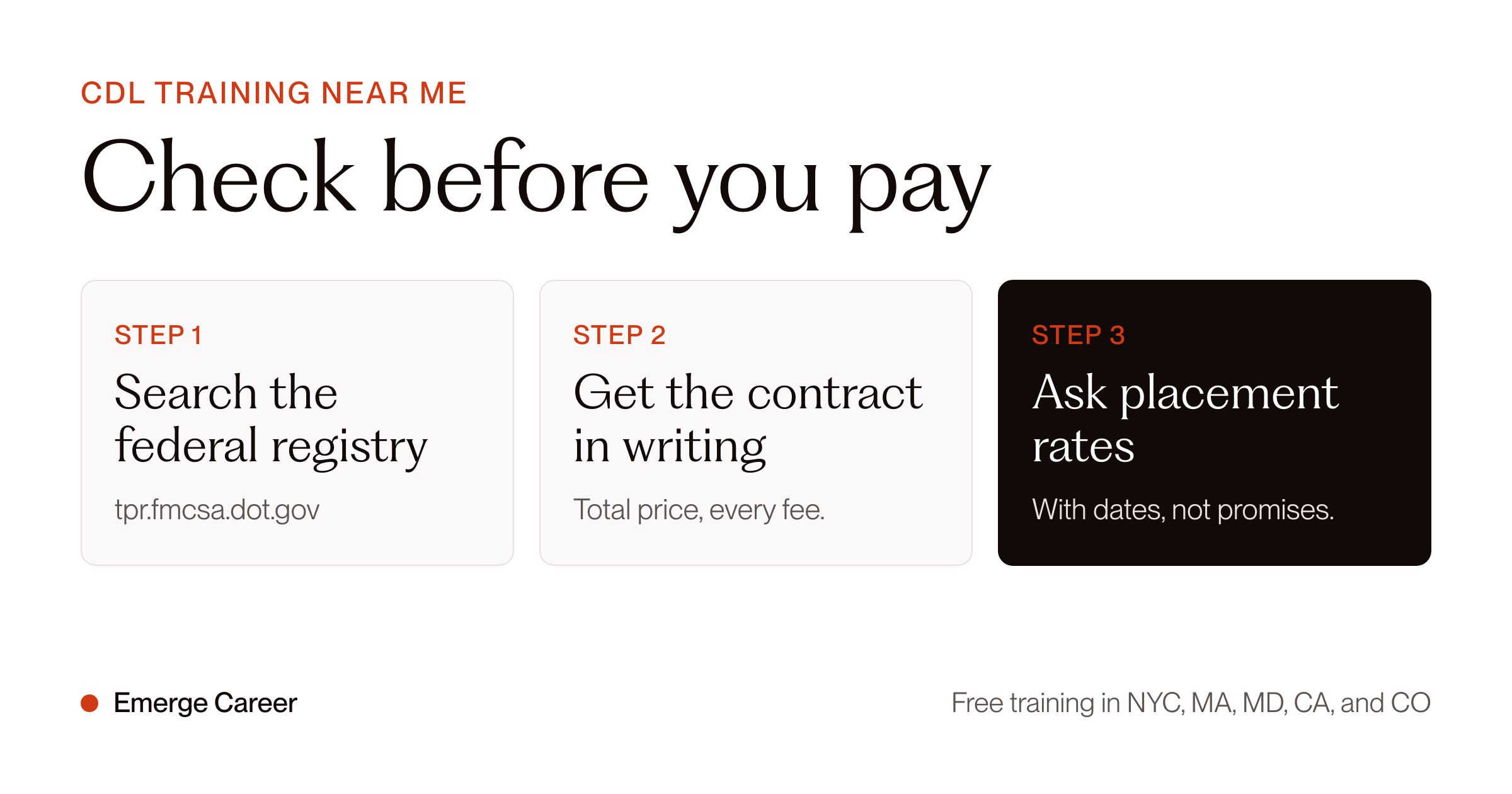
Check if you qualify for a government-funded program in your area. If you're in New York City with justice involvement, Emerge Career is free and has no contract. For everywhere else, search for your local American Job Center at CareerOneStop.org and ask about WIOA-funded CDL programs.
If no funded program is available, look at community colleges in your state. Check whether they're on the WIOA Eligible Training Provider List, which could let you use workforce grants to cover tuition.
If you need to move fast and can afford it, compare private schools. Prioritize programs with manual transmission training, high behind-the-wheel hours, and carrier partnerships for tuition reimbursement.
If none of the above work, then evaluate company-sponsored programs. Compare contracts from multiple carriers. Don't sign the first one a recruiter puts in front of you.
The math that matters
A CDL Class A driver can expect to earn $50,000 to $80,000 in their first year, with experienced drivers and specialized endorsement holders earning six figures. Even at the high end of training costs ($7,000 to $10,000 at a private school), most drivers recoup their investment within a few months of steady work.
At the low end, including free programs, the ROI is immediate. You spend nothing. You earn a credential. You start working.
The real question isn't whether CDL training is worth the money. It is. The question is whether you're paying more than you need to.
How to Get a CDL in NYC with a Criminal Record
A felony doesn't disqualify you from getting a CDL in New York. But nobody tells you that until you've already given up.
We train hundreds of justice-involved New Yorkers a year at Emerge Career. Most of them believed, at some point, that their record made a CDL impossible. It doesn't. The rules are specific, the process is clear, and the timeline from start to first paycheck is shorter than most people think.
Here's the real deal.
What actually disqualifies you (and what doesn't)
Federal law (FMCSA, 49 CFR 383.51) controls CDL eligibility. The FMCSA has said it directly: a felony conviction does not prohibit a driver from operating a commercial motor vehicle unless the offense involved the use of a motor vehicle.
That means assault, theft, drug possession (not involving a CMV), burglary, fraud, and most other felony convictions do not automatically bar you from a CDL. Period.
What does disqualify you:
- Using any motor vehicle to commit a felony (1 year for first offense, lifetime for second)
- Using a CMV to manufacture or distribute controlled substances (lifetime, no reinstatement)
- DUI/DWI while operating a CMV (1 year, 3 years if hauling hazmat)
- Leaving the scene of an accident involving a CMV
- Causing a fatality through negligent CMV operation
New York follows the federal minimums on these. The NY DMV can also deny your application if your license is currently suspended or revoked, but that's a separate issue from your criminal record (more on that below).
If your conviction doesn't involve a vehicle, you're eligible. Full stop.
The suspended license question
This is where it gets tricky for a lot of people. Your felony might not bar you from a CDL, but if you have a suspended or revoked license in New York, you need to clear that first.
Common reasons for suspension: unpaid tickets, unpaid child support, failure to appear in court, DWI-related revocations, lapsed insurance. Some of these are fixable in a single DMV visit. Others take longer.
Steps to clear a suspension in New York:
- Check your record through MyDMV (dmv.ny.gov) or call (518) 474-0774
- Resolve the underlying issue (pay fines, file paperwork, complete any required programs)
- Pay the suspension termination fee ($50 for most definite suspensions, $100 for Zero Tolerance violations)
- If revoked, apply for restoration through the DMV Driver Improvement Unit
If your CDL and non-CDL privileges are both revoked, you restore the non-CDL first, then the CDL at the end of its revocation period. You'll need to go to a NY DMV office in person to get your CDL back; that part can't be done online.
Bottom line: a suspended license is a speed bump, not a dead end. But you have to deal with it before starting the CDL process.
The actual steps: CLP to CDL in NYC
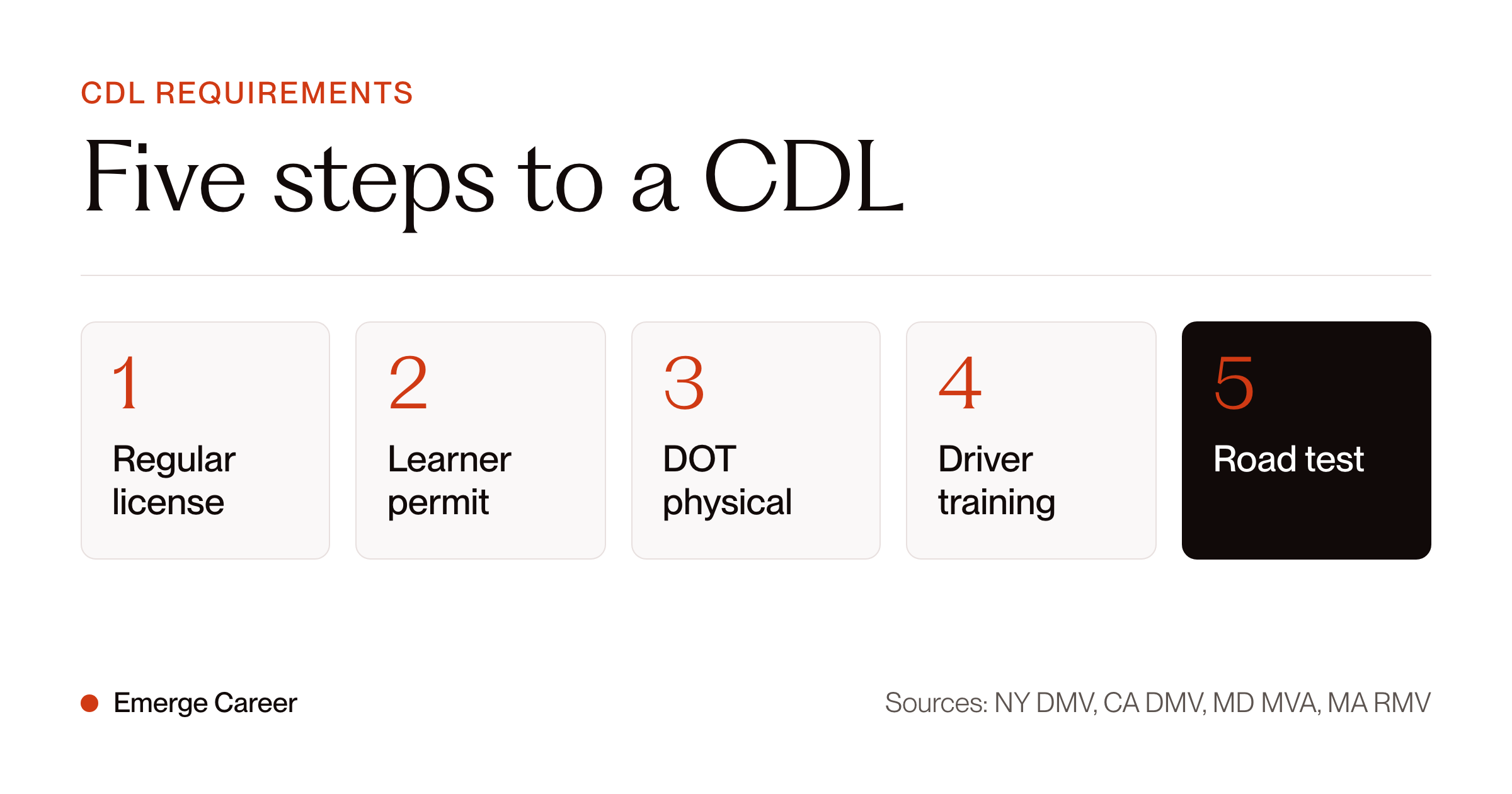
Here's the timeline, roughly 8 to 12 weeks from zero to hired.
Step 1: DOT physical
You need a medical certificate (Form MCSA-5876) from a certified examiner on the FMCSA National Registry. The exam covers vision (20/40 each eye), hearing, blood pressure, and general fitness.
In NYC, Emerge partners with CityMD for DOT physicals. Walk in, get examined, walk out with your medical card. No appointment hassle, no navigating the system blind.
Step 2: Get your CLP (Commercial Learner's Permit)
Go to a NY DMV office. You'll need:
- A valid NY Class D license (or restored license, if previously suspended/revoked)
- Your DOT medical certificate
- 6 original proofs of identity with current address
- $10 application fee
You'll take the general knowledge written test (50 multiple-choice questions) plus any endorsement tests you want. Study the NY CDL Manual (CDL-10), available free online from the DMV.
Pass the test, and you walk out with your CLP the same day. You must hold the CLP for at least 14 days before you can take the road skills test.
Step 3: Complete ELDT (Entry-Level Driver Training)
Federal law requires all new CDL applicants to complete an approved ELDT program. At Emerge, the Class A training program is free and funded by the NYC Mayor's Office of Criminal Justice. It covers classroom instruction, behind-the-wheel hours, and job placement support.
Step 4: Pass the CDL skills test
Three parts: pre-trip vehicle inspection, basic vehicle control, and on-road driving. You'll schedule this through the NY DMV online system. The fee is $40, and you'll test in the vehicle class you're applying for.
Pass, and you get a temporary CDL on the spot. Your permanent card arrives by mail in 3 to 4 weeks.
Step 5: Get hired
Class A CDL holders in New York are averaging $77,000/year. The driver shortage is real, and it's not slowing down. Emerge's job placement rate is 92%.
"Will my PO approve this?"
Short answer: almost always yes. CDL training is exactly the kind of program probation and parole officers want to see. It's structured, it has clear employment outcomes, and it keeps you on track. Many of our students are referred by their POs, or get written support from them during the program.
If you need documentation for your PO, courts, or benefits office, Emerge provides enrollment verification letters.
"Do employers actually hire people with records?"
Yes. Trucking companies are short roughly 80,000 drivers nationally, and the gap keeps growing. Many carriers have adopted fair-chance hiring policies. Some specifically recruit from reentry programs.
At Emerge, 92% of graduates land jobs. Our average starting salary is $77,000. These are not charity placements. Employers hire our graduates because they're trained, tested, and DOT-certified.
The background check process varies by employer. Most carriers care about driving-related offenses far more than unrelated felonies. Some have look-back windows (typically 3 to 7 years). A few won't touch certain convictions at all. The honest answer is that not every company will say yes. But enough will that employment is not the bottleneck.
"What if I want to haul hazmat?"
Hazmat endorsements require TSA background checks and fingerprinting. Certain felony convictions (including espionage, treason, sedition, terrorism-related offenses, and others on the TSA's disqualifying crimes list) will prevent you from getting hazmat clearance. For most CDL holders with records, this endorsement is the one real limitation. The good news: plenty of high-paying CDL jobs don't require hazmat.
The realistic timeline
Week 1-2: DOT physical, clear any license issues, study for CLP
Week 2-3: Take and pass the CLP written test at a NYC DMV
Week 3-10: Complete ELDT training (at Emerge, this is a free program)
Week 10-12: Pass CDL skills test, start interviewing, get hired
Some students move faster. Some need more time on license restoration or test prep. But 8 to 12 weeks from start to job offer is realistic for most people.
What to do right now
- Check if your NY license is valid or suspended (dmv.ny.gov or call 518-474-0774)
- Look up your conviction. If it didn't involve a motor vehicle, you're eligible for a CDL.
- Apply to Emerge Career at emergecareer.com. The program is free. We'll help you get your DOT physical, prep for the CLP, train for the skills test, and place you in a job.
A record doesn't erase your ability to drive a truck, earn $77K, and build a career. The federal government says so. We've helped hundreds of people prove it.
How to Get a CDL in New York (2026): Permit, Training, and Job Placement Guide
What you actually need before you start
You need a valid New York State driver license (Class D, E, or Non-CDL C). You need to be at least 18. And you need to be a U.S. citizen or lawful permanent resident. NY DMV offices are currently unable to process CLP applications for temporary visitors following a federal rule change in early 2026.
If you're 18 to 20, you can get a Class A CDL through the federal Young Adult Training Program, but you're limited to driving within New York State only and need at least 300 hours of supervised behind-the-wheel training.
Interstate driving (crossing state lines) requires you to be 21 or older. So does hauling hazardous materials.
Step 1: Pass the DOT physical
Before you touch anything at the DMV, get your DOT physical. This is a medical exam conducted by a certified examiner listed on the FMCSA's National Registry. It checks vision (20/40 in each eye), hearing, blood pressure, and overall fitness to operate a commercial vehicle.
The exam costs $75 to $150 depending on the provider. In NYC, CityMD locations offer DOT physicals as walk-ins. You can also search the FMCSA registry at nationalregistry.fmcsa.dot.gov to find a certified examiner near you.
One thing to know: New York is one of the states still on paper-based medical certification (not yet on the NRII electronic system as of early 2026). Keep a copy of your Medical Examiner's Certificate. You'll need it.
The DOT physical is valid for 24 months.
Step 2: Study for the CLP exam
The Commercial Learner's Permit (CLP) is your written test. For a Class A CDL (tractor-trailers), you need to pass three knowledge tests:
- General Knowledge (50 questions, 80% to pass)
- Combination Vehicles (25 questions, 80% to pass)
- Air Brakes (25 questions, 80% to pass)
All three are taken at a NY DMV office. The application fee is $10, which covers all written tests taken the same day. If you don't pass one and come back another day, that's an extra $5.
Once you pass a section, it's done. You don't retake it. You get unlimited attempts on any section you haven't passed yet, though the DMV may limit how many times you can test in a single day.
Tests are available in English, Spanish, Chinese, and Russian.
Study the official New York CDL Manual (CDL-10). It's free from the DMV website or any DMV office. The general knowledge section alone covers vehicle inspection, cargo handling, traffic laws, hazardous conditions, and federal regulations. It's dense. Give yourself two to three weeks of focused study.
If you're in NYC, Emerge Career runs free weekly Study Hall sessions in Harlem, the Bronx, Brooklyn, and Queens where you can prep for the permit exam with other students and a coach. More on that below.
Step 3: Get your CLP at the DMV
Walk into a NY DMV office (no appointment needed for written tests, but check your local office), bring your documents, and take the tests.
What to bring:
- Your current NY driver license
- Proof of U.S. citizenship or lawful permanent residency
- Your DOT Medical Examiner's Certificate
- $10 application fee
Pass the tests and you'll walk out with a CLP valid for 12 months. The clock starts ticking: you have 12 months to complete training and pass your skills test, or you retake everything.
You must hold the CLP for at least 14 days before you can schedule a road test. Use that time to start training.
Step 4: Complete Entry-Level Driver Training (ELDT)
Federal law requires all new CDL applicants to complete Entry-Level Driver Training through a program registered on the FMCSA Training Provider Registry (TPR). No exceptions.
ELDT has two components: theory (classroom) and behind-the-wheel. You cannot schedule your skills test until your training provider reports your completion to the TPR.
Your training options in NYC
Emerge Career (Free)
Emerge is a free CDL Class A job training program based in New York City, funded by the NYC Mayor's Office of Criminal Justice. The program covers ELDT, permit prep, DOT physical coordination, and job placement after graduation. 89% graduation rate. 92% job placement rate. Average starting salary for graduates: $77K. If you qualify, you pay nothing. emergecareer.com/nyc
Private CDL schools ($4,000 to $8,000+)
NYC and the surrounding area have dozens of private CDL training schools. Costs range widely. Some offer financing, some don't. Quality varies. Check the FMCSA Training Provider Registry to make sure any school you're considering is actually registered. If they're not on the TPR, their training doesn't count.
Community colleges
A few SUNY and CUNY-adjacent programs offer CDL training, typically at lower cost than private schools but with longer timelines.
Step 5: Pass the CDL skills test
The skills test has three parts:
- Pre-trip vehicle inspection. You walk around the vehicle and explain every component you're checking and why. The examiner has a checklist. You can bring the CDL Vehicle Inspection Memory Aid (pages 11-12 of the CDL manual) to the test.
- Basic controls. Straight-line backing, offset backing, and parallel parking with a tractor-trailer in a controlled area.
- Road test. Driving on public roads with the examiner. Left turns, right turns, lane changes, highway merging, downshifting, general vehicle control.
Schedule through the DMV Road Test Scheduling System. The road test fee is $40. If you need to reschedule, do it at least 3 days in advance or you lose the fee.
Road test locations vary, and your training program will typically prep you on which site you'll test at and what to expect there.
Step 6: Get your CDL
Pass the skills test and pay the CDL license fee. Total fees across the whole process run about $215 (not counting training costs), though your training program may cover some of these.
Your CDL is valid for up to 8 years, and you'll need to renew your DOT physical every 24 months to keep your medical certification active.
The job market on the other side
Class A CDL drivers in New York City are in demand. The numbers:
- Average annual salary for CDL Class A drivers in NYC: $80,000 to $96,000
- Local drivers (hourly): $28 to $38/hour
- Top earners with specialized freight or hazmat endorsements: $100,000+
- Entry-level drivers typically start around $60,000
These numbers are higher than most of the country because of congestion, delivery complexity, tolls, and the sheer volume of freight moving through the metro area. Companies pay a premium for drivers who can handle NYC roads.
Job types range from local delivery and distribution to regional OTR (over-the-road), construction/dump truck, and specialized hauling. Most new CDL holders start with local or regional routes and work up.
Total timeline
If you move with purpose:
- Weeks 1-2: DOT physical + start studying for the CLP
- Weeks 2-3: Pass CLP exam at DMV
- Weeks 3-10: Complete ELDT training (length varies by program)
- Weeks 10-12: Pass skills test, receive CDL
Eight to twelve weeks, permit to CDL in hand. Add a week or two for job placement, and you're earning.
If you're in NYC: Emerge Career
Emerge Career runs a free CDL Class A training program for New York City residents. The program covers everything in this guide: permit prep, DOT physical coordination, ELDT training, skills test preparation, and job placement.
You don't pay for training. You don't pay for the DOT physical. You get coached through every step.
The program is funded by the NYC Mayor's Office of Criminal Justice, and it's built for people who are serious about starting a career in trucking but might not have $5,000 to $8,000 to hand a private school.
89% of students who start the program graduate. 92% of graduates land jobs. Average starting salary: $77K.
If that sounds like you, apply at emergecareer.com/nyc.

Overview: Emerge Career's CDL Program
How Emerge Career's CDL Training Program Works
Step 1: Application & Eligibility Check
Start by filling out our online application. We'll ask questions to see if you qualify for our government-funded program. Our application is continuously improving as we learn more about what helps students succeed in the CDL industry. After completing the application, you’ll hear back in a day (often within seconds) whether you can move forward. Our (non-exhaustive) eligibility requirements are listed here.
Note: While we try to make our application as comprehensive as possible, sometimes we miss stuff! We do a background check and driving record review later in the process to confirm your information.
Our eligibility requirements are constantly evolving as the world around us changes. We update our criteria based on:
- Funding changes – New government grants or shifts in program funding may affect who we can serve
- Employment and labor market data – As trucking industry hiring standards shift, we adjust our requirements to ensure you have real job prospects after training
- Compliance updates – DOT regulations and insurance requirements change regularly, which can impact eligibility
If something comes up during your enrollment process that affects your eligibility—whether it's new information from your background check or a change in our program requirements—we'll let you know as soon as possible and work with you to understand your options.
Step 2: Online Permit Prep Training
Once you're approved, you'll start our online training course. This includes 21 videos to prepare you for your commercial learner's permit (CLP) exam, plus over 100 practice quizzes to help you study and feel confident as you work towards getting your CLP.
Step 3: Get Your Commercial Learner's Permit
After finishing the online training, you'll need to get two things: your Class A Commercial Learner's Permit and your DOT Medical Examiner’s Certificate. You need both of these before you can legally drive a commercial truck, and we’ll coach you on how to get them!
Step 4: Enrollment Interview
Once you've uploaded a photo of your permit to your profile, we'll schedule you for a virtual Enrollment Interview. This is where we get to know you and figure out if our program is a good fit. On this call, we'll:
- Confirm your eligibility for the program (income, criminal background, driving record, justice-involvement)
- Ask about marijuana use—you'll be randomly drug tested throughout the program and will need to be testing negative at the time of enrollment
- Confirm that you can make trucking school work
- Learn about your financial situation
- Talk about how you'll get to and from training
- Discuss your current job and schedule flexibility
- Your commitment and reasons for wanting to become a truck driver
Treat this like any job interview. Be professional, come prepared, and be honest about your situation.
Note on employment barriers: During this process, we conduct a background check and driving record review (7-year lookback). If anything comes up that wasn't caught in the initial application—like certain criminal history or driving violations—we may ask you to secure a pre-hire offer letter before enrolling in trucking school. This ensures you have a job waiting for you after training, rather than investing time and money only to face barriers later.
We reserve the right to decline participation from individuals who don't meet our requirements or follow program guidelines—all of which are detailed in our Terms of Service. We evaluate candidates across these areas:
What we look for:
- Professionalism & Conduct – We're looking for students who are respectful, reliable, and serious about building a career. You'll need to demonstrate professional behavior and the ability to work well with instructors, peers, and future employers.
- Employability – We partner with industry employers, trucking associations, and compliance experts to assess whether you have the foundational soft skills and background needed to secure employment after training. This helps us match participants with realistic job prospects.
- Employment Commitment – Our program prioritizes immediate employment in your trained field. While we support continued learning, your primary goal should be securing work related to your credential. This is a one-time training opportunity, and we want to invest in participants genuinely committed to working.
- Training Readiness – You'll need to manage a demanding schedule and have reliable transportation to complete the program. We need to know you can commit to attendance and stay on track.
- Coachability – This is an accelerated program led by experienced professionals who've refined best practices working with hundreds of participants nationwide. We expect you to follow our program structure and be open to feedback. If you believe you're above the process or don't need to follow our guidelines, this program isn't the right fit. We're looking for participants who are genuinely committed to learning, not those who think they can opt out of key components because they work differently.
Step 5: Enrolling in Trucking School
Once you're approved, there are a few final steps:
Yard Readiness Assessment – A 30-minute call where you'll recall key parts of the pre-trip inspection process from memory. We'll send you study materials beforehand, including:
- Audio guides/podcasts you can listen to anytime
- Interactive flashcards
- Memorization games
You get 3 attempts to pass (no-shows count as attempts), and you need to pass before starting school. While most students pass on either the first or second attempt, failure to pass all 3 attempts will result in removal from the program.
Why this assessment matters: After working with hundreds of students across the country, we've learned that memorization is the #1 reason people struggle to get their CDL at trucking school. The pre-trip inspection requires you to recall specific details on the spot—there's no cheat sheet when you're testing. This assessment helps you build strong memorization habits early, sets you up to get the most out of your time at our partner school, and gives us confidence that you're ready for the demands of CDL training.
Don't worry – we'll give you everything you need to study and succeed.
Turning in documents – Because we're government-funded, we need copies of your Social Security card, driver's license, proof you can legally work in the US, and proof of your income. We may request additional documentation based on your specific situation.
Important: You have two weeks from getting your permit to complete these steps. If you don't complete them in time, we may put you on hold so we can work with students who are ready to go.
Step 6: Training at Our Partner Schools
This is the hands-on part. You'll complete your required driving hours at one of our partner trucking schools, working toward your Class A CDL. We've carefully vetted each of our partner schools to ensure they meet our quality standards and can provide the training you need to succeed.
Throughout your training, your assigned coach will check in with you 2-3 times to see how things are going and help troubleshoot any issues before they become bigger problems.
Showing up matters—a lot. "On time" means arriving 10-15 minutes early—the same standard employers will expect from you as a professional driver.
Unexcused absences or repeated tardiness will result in removal from the program. If you miss training or show up late, you must communicate with your coach immediately and provide documentation for excused absences (medical appointments, family emergencies, etc.). One unexcused absence or repeated lateness is enough for removal.
This isn't about being strict for no reason. We have limited resources and need to focus on students who show up on time, communicate well, and act professionally—the same things employers will expect from you as a truck driver. Professional drivers are responsible for expensive equipment and tight delivery schedules. Building these habits now is essential to your success in the industry.
Step 7: Help Finding a Job
We'll support you in finding your first driving job. Here's what that looks like:
- Connecting you with companies we partner with and making personal introductions to hiring managers—you're not just applying online
- Helping you build a strong resume using our resume builder tool
- Creating and optimizing your job search profiles on job boards to increase your visibility to employers
- Providing you with talking points for discussing any employment barriers in interviews
- Sending your resume directly to hiring companies
Important to know: While we carefully screen everyone and prepare you well, we can't guarantee you'll get hired in a timely manner. Companies change their hiring rules often, and they make the final decision—not us. What we can promise is to not give up on you if getting hired proves to be more difficult than anticipated.
Step 8: After You Get Hired
We stay connected even after you land a job. Once you're hired, we'll ask you to tell us where you're working and share some official paperwork. This stays private and is never posted anywhere—we only use it to show that our program works, which helps us keep getting funding to help more students like you.
Your Journey at a Glance
- Apply – Fill out our application and find out if you're eligible
- Study – Complete 21 videos and 100+ practice quizzes online
- Get Your Permit – Obtain your CLP and DOT Medical Certificate
- Interview – Meet with us to confirm fit and readiness
- Enroll – Pass the Yard Readiness Assessment and submit documents
- Train – Complete hands-on driving hours at a partner school
- Get Hired – Receive job placement support and connect with employers
- Stay Connected – Share employment info to help us keep the program running
Ready to start? If you're serious about a trucking career and willing to put in the work, we're here to help you every step of the way. When you succeed, we succeed—and we're committed to being honest partners as you work toward becoming a professional CDL driver.
If you have any questions about our CDL program or other vocational program offerings, please email support@emergecareer.com.
Read about our eligibility guidelines here.

How to Schedule Your CLP Exam (CDL Written Test)
If you’re taking the first step toward a rewarding career in commercial driving, scheduling your Commercial Learner’s Permit (CLP) exam is an exciting milestone. This test, also known as the CDL written test, is your gateway to hitting the road with confidence. Let’s guide you through the process so you can schedule your exam with ease.
General Steps to Schedule Your CLP Exam
- Visit Your State’s DMV or RMV Website: Start by going to your state’s Department of Motor Vehicles (DMV) or Registry of Motor Vehicles (RMV) website. These sites are your go-to resource for scheduling and preparing for the CLP exam.
- Find the Scheduling Section: Most DMV or RMV websites provide a dedicated section for scheduling your CDL-related appointments. Look for links that specifically mention "CLP Exam" or "CDL Written Test."
- Follow Instructions on Required Documents: Ensure you have all the necessary paperwork. These usually include:some text
- Proof of identity and residency.
- Your Social Security number.
- Valid Driver’s license
- DOT Physical
- Any other state-specific requirements.
- Prepare for the Exam:some text
- Download or request the CDL Manual from your state’s DMV website.
- Study key sections relevant to the written test.
- Check Fees and Payment Options: Each state sets its own fees for the CLP exam. Check the cost and confirm acceptable payment methods (e.g., credit card, check, or cash).
Helpful Resources
Your state’s DMV website will often provide:
- Tutorials or videos on how to schedule your exam.
- Downloadable resources like the CDL manual.
- A detailed breakdown of fees and test requirements.
State-Specific Information
To get you started, here is a handy table with resources for four states that Emerge Career operates in. Each link directs you to the appropriate page for scheduling, required documents, and preparation materials.
State DMV Matrix
| State | DMV/RMV Link | How to Schedule | CLP Requirements | Cost |
|---|---|---|---|---|
| California | https://www.dmv.ca.gov | Scheduling in CA | Requirements | $98 |
| Colorado | https://www.colorado.gov/dmv | Scheduling in CO | Requirements | Free for first exam attempt, $19 for the permit |
| Massachusetts | https://www.mass.gov/orgs/massachusetts-registry-of-motor-vehicles | Scheduling in MA | Requirements | $50 |
| New York | https://dmv.ny.gov | Scheduling in NY | Requirements | $10 |
State-Specific Department of Motor Vehicle Websites
This table provides direct access to each state's official DMV website, where you can find information on driver's license applications, vehicle registrations, and other related services. Please note that specific services and requirements may vary by state, so it's advisable to consult the respective website for the most accurate and up-to-date information.
State DMV Websites
Scheduling your CLP exam doesn’t have to be daunting. With these tips and resources, you’re already well on your way to success. Remember, every journey begins with a single step, and this one leads to a promising future on the open road!
Do you have a history of criminal justice involvement including: incarceration, probation, parole, diversion programs and are looking for a new beginning? Start your commercial trucking career today with our Free CDL Training Program. Apply today!

How to Get Prepared for CDL Training Behind-The-Wheel
1. Pre-Trip Inspection
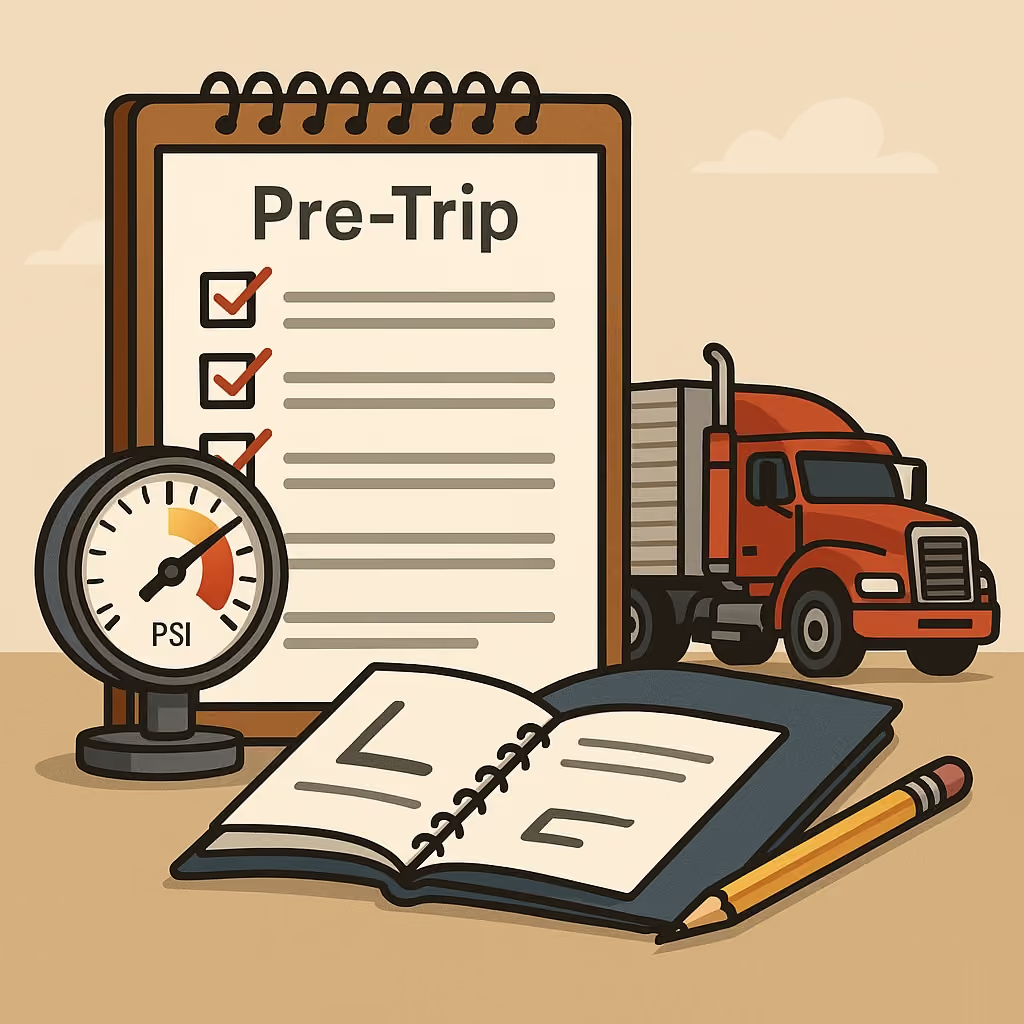
The pre-trip inspection is a crucial part of your CDL training, and a large portion of it is all about memorization. You need to commit every step of the inspection checklist—ranging from tire pressure checks to fluid levels—to ensure nothing is overlooked. Here are some key points along with additional video resources:
- Memorization is Key:
Memorize the process step-by-step, ensuring that every detail from the engine compartment to the trailer is checked. - Practice and Repetition:
Use hands-on practice to develop a strong routine. Emerge Career’s AI simulation tests help reinforce these vital steps through repeated scenarios. - Common Pitfalls:
Studies at Emerge Career have shown that nearly 90% of CDL failures occur during the pre-trip inspection due to overlooked details.
Helpful YouTube Videos:
- CDL Class A Pre-Trip Inspection: COMPLETE GUIDE (2024)
- 5 Tips to Memorize the CDL Pre Trip Inspection
2. Air Brakes
Air brakes are a critical system that require detailed memorization for safe operation. Understanding this system means knowing the components, safety checks, and specific values you need to monitor. Consider the following key facts:
- Core Components:
Familiarize yourself with parts such as the air compressor, reservoirs, brake chambers, and slack adjusters. - Key Facts to Memorize:
- Air Pressure PSI: It’s essential to know that the brake system should normally operate around 90–120 PSI, and you must be aware of the low and high-pressure cutoffs.
- Pre-Chamber Check: Before activating the brakes, ensure that the air pressure in the pre-chamber is within the manufacturer’s specified range.
- Emergency Systems: Understand the functionality of the spring brakes (often called parking brakes), which activate automatically if air pressure drops too low.
- Air Pressure PSI: It’s essential to know that the brake system should normally operate around 90–120 PSI, and you must be aware of the low and high-pressure cutoffs.
- Safety Checks and Pitfalls:
Missing or incorrectly performing any of these checks can lead to dangerous situations on the road—one of the main reasons behind CDL test failures. - Emerge Career Support:
Emerge Career offers several practice and learning tools to reinforce your training outside of the yard.
Helpful YouTube Videos:
3. Maneuvers
Behind-the-wheel maneuvers are designed to test your precision, control, and overall driving skills in a variety of conditions. During training, you’ll be expected to execute several key maneuvers:
- Straight Line Backing:
Developing the ability to maintain a straight trajectory is essential. - Offset Parking:
Learn to maneuver and park your truck in confined spaces safely. - Parallel Parking:
Master techniques for backing up accurately, including the necessary mirror adjustments and spatial judgment.
For a better understanding, here are some additional YouTube tutorials to help you visualize each maneuver:
4. Road Driving
After mastering the pre-trip inspection, air brakes, and maneuvers, you’ll progress to the road driving portion of your training. This phase tests your ability to apply all learned skills in real-world traffic conditions:
- Highway and Urban Driving:
Evaluate your ability to navigate both highway scenarios and complex urban intersections. - Handling Emergencies:
Be prepared to handle unexpected situations—merging safely, managing blind spots, and executing emergency maneuvers. - Continuous Skill Development:
Remember that safe driving is a lifelong learning process. Constant practice and review will help you keep your skills sharp even after passing your CDL exam.
For additional guidance on road driving strategies, consider these top YouTube resources:
Ready for the Next Step?
If you’re serious about launching your career as a professional driver and taking your CDL training to the next level, Emerge Career is here to support you.
Gear up, practice diligently, and get ready to hit the road with confidence and well-honed skills!

How Long Is a CDL Permit Good For — And How to Renew It
If you’re planning to get your commercial driver’s license (CDL), one of the first steps on your journey is earning your commercial learner’s permit (CLP). But how long does that permit last, and what should you do if it expires before you’re ready to take the next step?
Let’s break it down.
What Is a CDL Permit?
A Commercial Learner’s Permit (CLP) allows you to practice driving a commercial vehicle on public roads while supervised by a qualified CDL holder. It’s similar to a learner’s permit for a regular driver’s license but specific to commercial vehicles.
You’ll need your CLP before you can schedule and take the CDL skills test, which includes vehicle inspection, basic controls, and a road test.
How Long Is a CDL Permit Good For?
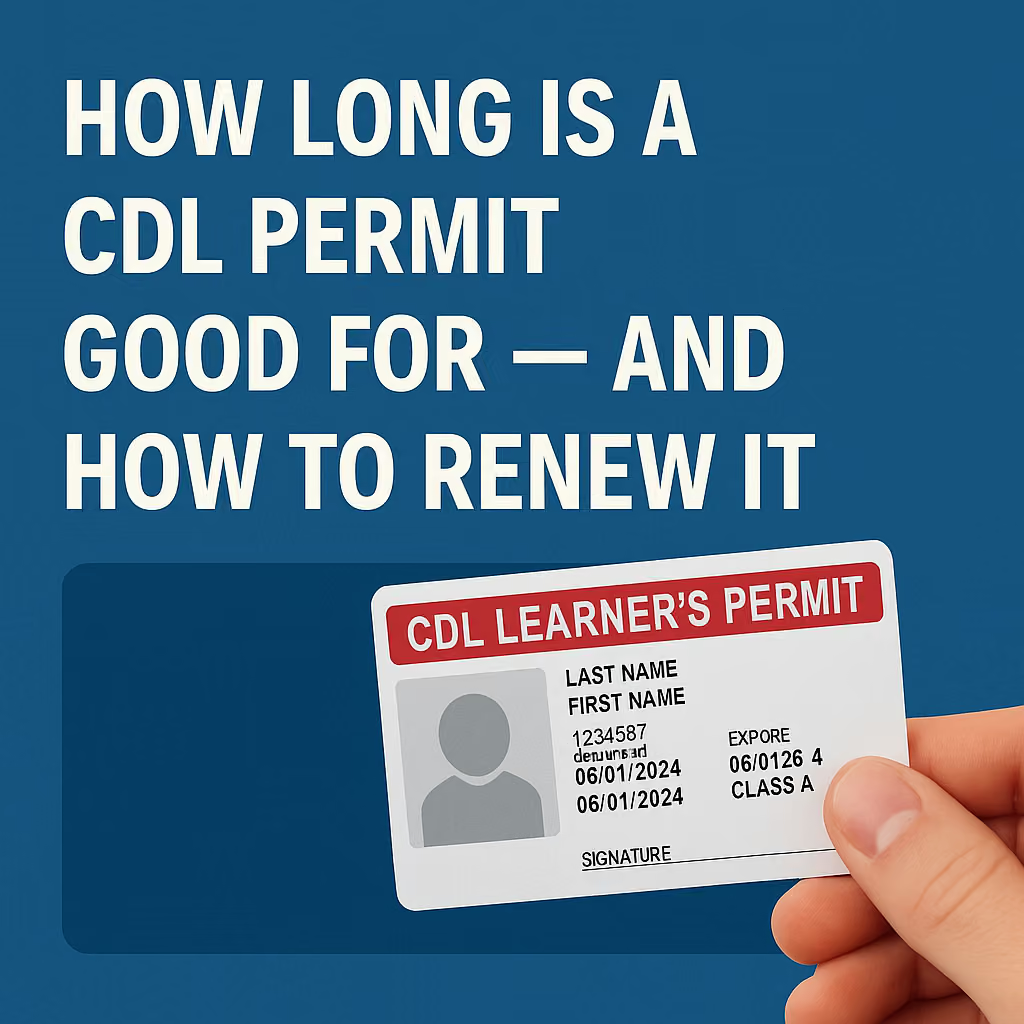
A CDL permit is typically valid for 180 days from the date it’s issued. This gives you roughly six months to practice and prepare for your CDL skills test.
If you’re not ready to take the test within that time, most states will allow you to renew your CLP once, extending it for an additional 180 days. That means you can potentially have up to one year total with a valid CLP.
It’s important to note that the exact duration and renewal policies can vary by state, so it’s a good idea to check with your local Department of Motor Vehicles, RMV, or licensing agency.
How Do You Renew a CDL Permit?
The process for renewing your CLP will depend on your state, but in most cases, you’ll need to:
- Visit or Call your DMV/RMV: Most times this can be done through a phone call or online. Some states will require an in-person visit.
- Provide identification: Just like when you applied the first time.
- Pass applicable tests again: Some states may require you to retake the written knowledge tests.
- Pay a renewal fee: The cost will vary by location. It’s often free.
Remember, you can usually only renew your permit once. If your second permit expires, you may have to restart the process — including reapplying and repassing all required knowledge tests.
What Happens If Your CDL Permit Expires?
If your CLP expires and you don’t renew it in time, you’ll likely need to:
- Reapply for a new CLP.
- Retake all required written knowledge exams.
- Pay the associated fees again.
This can delay your CDL training and add unnecessary costs. That’s why it’s important to track your permit’s expiration date and plan your CDL exam accordingly.
Helpful Links: How to Renew Your CDL Permit by State
Here are direct links for CDL permit renewal information for students in the following states:
- California: CDL Renewal and Permit Information – California DMV
- Massachusetts: Apply for a CLP – Mass.gov
- New York: Get a CDL Permit – New York DMV
Be sure to check each site for the most up-to-date steps, fees, and testing requirements.
Bottom Line
Your CDL permit is a temporary step toward earning your commercial driver’s license. It typically lasts 180 days, and you’ll often get one renewal of the same length. Use this time wisely to build your skills, complete training, and prepare for your CDL exam.
If you’re unsure about your state’s specific rules, reach out to your local DMV for the most accurate guidance — and don’t let your permit expire without a plan!

What Conditions and Medications Might Disqualify You from a DOT Medical Exam?
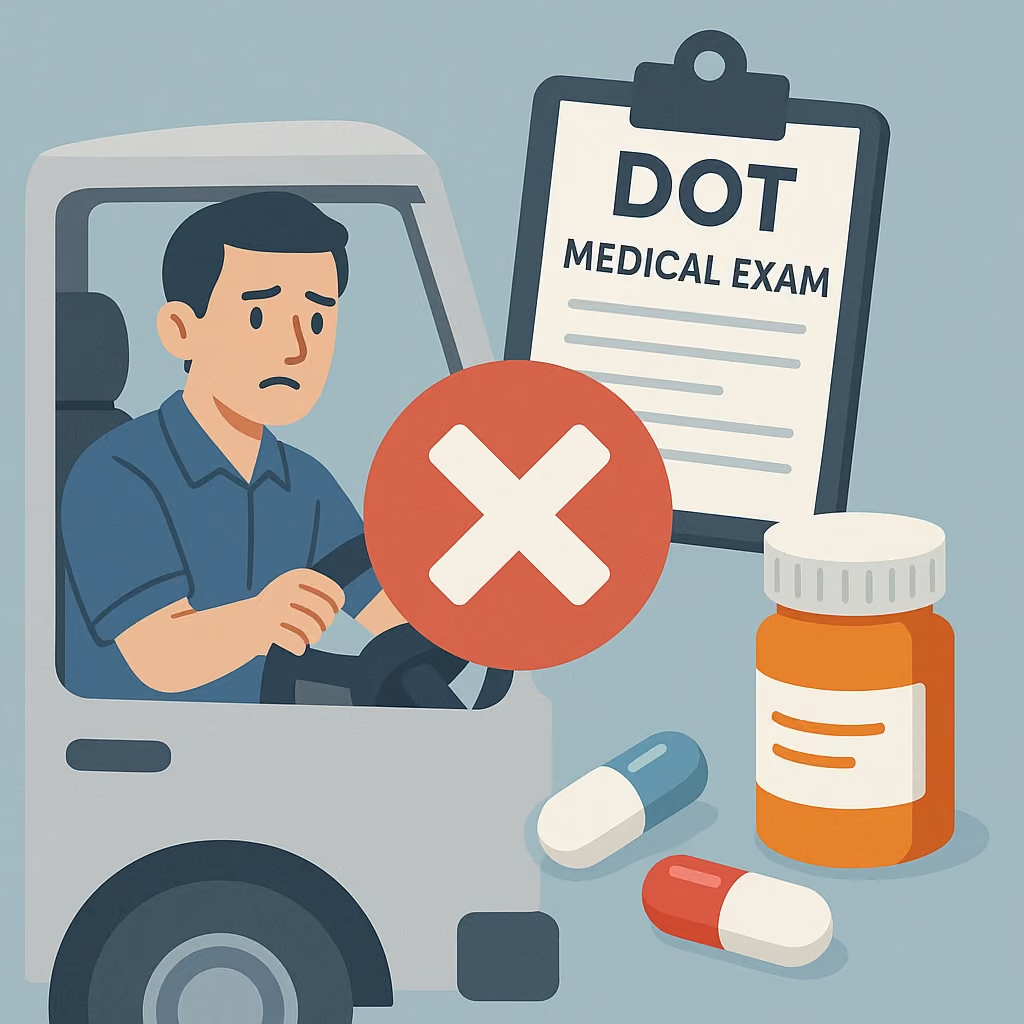
If you're preparing to get your Commercial Driver’s License (CDL), one key step you'll face is the Department of Transportation (DOT) medical examination. The DOT physical assesses your health to ensure you can safely operate commercial vehicles. However, certain medical conditions or medications can disqualify you from obtaining DOT certification. Here's a general overview to help you understand what might impact your eligibility.
Medical Conditions That Could Be Disqualifying
Here are some of the common conditions that could potentially disqualify you from passing the DOT medical exam:
- Cardiovascular Issues:
- Recent heart attacks or heart surgeries
- Uncontrolled high blood pressure (hypertension)
- Severe arrhythmias
- Respiratory Conditions:
- Severe asthma or COPD that isn't well-controlled
- Sleep apnea that is untreated or improperly managed
- Neurological Disorders:
- Seizure disorders, such as epilepsy
- Narcolepsy or uncontrolled sleep disorders
- Recent stroke or transient ischemic attack (TIA)
- Vision and Hearing Problems:
- Poor vision not correctable to minimum DOT standards (typically 20/40 in each eye)
- Hearing loss not correctable or beyond acceptable DOT limits
- Diabetes:
- Uncontrolled diabetes or insulin-dependent diabetes (specific waivers may apply)
- Mental Health Conditions:
- Severe untreated depression
- Bipolar disorder or schizophrenia, particularly if untreated or poorly controlled
- Substance Abuse:
- History of drug or alcohol dependency, especially if recent or unresolved
Medications That Could Affect Eligibility
Certain medications might impact your ability to safely operate commercial vehicles, potentially disqualifying you from receiving your DOT medical certification. These include:
- Narcotic Painkillers: Oxycodone, hydrocodone, morphine, or fentanyl.
- Sedatives and Hypnotics: Medications like benzodiazepines (Xanax, Valium) and sleeping pills (Ambien).
- Antipsychotics and Strong Antidepressants: Certain medications used for severe psychiatric conditions.
- Stimulants: Amphetamines or other stimulant medications, unless prescribed and carefully monitored for conditions like ADHD.
What To Do If You Have These Conditions or Medications
Having a medical condition or taking medication does not always mean you're automatically disqualified. Many conditions can be acceptable if properly managed and monitored. Here's what you can do:
- Consult a DOT Physician: A certified DOT physician can provide accurate, personalized advice and outline any steps you might need to take to qualify.
- Manage Your Condition: Regular monitoring, medication adjustments, or lifestyle changes could make a significant difference.
- Seek Exemptions or Waivers: The FMCSA may grant waivers or exemptions for certain conditions if you can demonstrate proper control and safety.
Final Thoughts
Understanding which conditions and medications could affect your DOT medical exam is crucial. While this overview provides general guidance, always consult a certified DOT medical examiner for personalized advice to ensure you're on the right track toward obtaining your CDL and safely hitting the road.

Step-by-Step Guide to Reinstate a Driver’s License in New York
Why Reinstating Your Driver’s License Matters
A driver’s license is more than just a permission slip to drive—it’s a key to independence, opportunity, and mobility. For many, reinstating their driver’s license is a crucial step toward accessing better job opportunities, especially in industries like commercial trucking, where a valid license is a requirement. Beyond employment, a driver’s license serves as a primary form of identification, essential for opening bank accounts, signing leases, and navigating countless other aspects of daily life. Whether your goal is to start a new career, gain independence, or rebuild your future, taking the steps to reinstate your license is an investment in yourself and your success. At Emerge Career, we’re here to support you every step of the way.
1. Determine the Reason for Suspension or Revocation
Check your suspension or revocation notice from the New York Department of Motor Vehicles (NY DMV). You can also log into your NY DMV account or contact the DMV directly to identify the reason.
New York DMV Contact Information:
📞 Phone: 1-518-486-9786
🌐 Website: dmv.ny.gov
2. Address the Cause of Suspension
Take action based on the reason for your suspension. This may include resolving unpaid fines, completing court-mandated programs, or paying the Driver Responsibility Assessment fee.
3. Pay the Reinstatement Fee
Reinstatement fees in New York depend on the type of suspension or revocation and typically range from $50 to $400.
If you are an Emerge Career participant enrolled in one of our vocational training programs, we will support your license reinstatement (up to $300) and work with you to develop an action plan to cover the remaining costs. Interested in training? Sign up here.
4. Complete Required Programs
Enroll in any mandatory programs, such as the Drinking Driver Program (DDP), and keep all completion certificates for DMV submission.
5. Submit Proof of Insurance (SR-22, if Required)
For serious violations, you may need to submit an SR-22 form from your insurance provider to the DMV.
6. Apply for Reinstatement at the DMV
Visit your local DMV office or apply online (if eligible). Bring all required documents and pay the necessary fees to complete the reinstatement process.
Already An Emerge Career Student?
We’re here to help! Reach out to Emerge Career for support with the info below. If unpaid fines or fees are preventing you from reinstating your license, we can help. We’ll work with you to create a plan of action to resolve these barriers so you can pursue your CDL truck driving career.
Contact Emerge Career:
📞 Phone: 337-509-8592
📧 Email: support@emergecareer.com
🌐 Website: app.emergecareer.com/login
Not an Emerge Career Student Yet?
If you’ve experienced incarceration, parole, probation, or an arrest, then you’re eligible for a Free CDL scholarship. If that’s you, don’t wait. Claim one of our limited scholarships today by signing up here.
%20-%20Emerge%20Career.avif)
What is the Commercial Learner's Permit Exam (aka CDL Written Exam)?
If you’re aspiring to become a commercial driver, the first major step on your journey is passing the Commercial Learner's Permit (CLP) exam. This written test is your gateway to obtaining a permit that allows you to practice driving a commercial vehicle under supervision. Let’s break down what you need to know to ace this crucial milestone.
What is the CLP Exam?
The Commercial Learner’s Permit exam is a multiple-choice test designed to assess your knowledge of commercial driving rules and regulations. Passing this exam is required to get your CLP, which enables you to practice behind the wheel of a commercial vehicle under the guidance of a qualified driver.
What Does the Test Include?
The CLP exam is divided into key sections, each covering an essential area of commercial driving:
- General Knowledge: 50 questions covering fundamental driving rules and safety practices.
- Air Brakes: 25 questions focused on understanding air brake systems.
- Combination Vehicles: 20 questions addressing the dynamics and safety considerations of driving combination vehicles.
You must answer at least 80% of the questions correctly in each section to pass. While you need to pass all three sections to receive your permit, you don’t necessarily have to pass them all in one sitting.
How to Prepare for the CLP Exam
- Complete Your Studies:
- Study the CDL manual thoroughly. Many states provide a free downloadable version online.
- Take practice exams to solidify your understanding. You can find practice tests online or through an Entry Level Driver Training course.
- Schedule Your Exam:
- Visit your state’s DMV/RMV website to book an appointment or find information about walk-in options.
- Make sure to verify the required documents and fees for your state.
- Stay Relaxed:
- Get a good night’s sleep before the exam.
- Stay calm and confident. Remember, you don’t need a perfect score—an 80% in each section is enough to pass.
What to Bring on Exam Day
To ensure a smooth experience on exam day, come prepared with the required documents. These are the typical documents you will need, but be sure to check your state’s requirements.
- Your Driver’s License
- Social Security Card
- Medical Examiner’s Certificate (DOT Physical)
- Birth Certificate or Passport
- Proof of residency (e.g., utility bill, lease)
Tips for Success on Exam Day
- Arrive Early: Plan to be at the testing location at least 30 minutes before your appointment to allow time for check-in.
- Read Carefully: Take your time to read and understand each question before answering.
- Manage Your Time: Keep an eye on the clock to ensure you have enough time to complete the test.
Why the CLP Exam Matters
Passing the CLP exam is a critical step toward earning your Commercial Driver’s License (CDL) and launching your career as a professional driver. It’s not just about checking a box—it’s about gaining the foundational knowledge you’ll need to be safe and successful on the road.
With proper preparation and a positive mindset, you can conquer the CLP exam and move one step closer to achieving your goals. You’ve got this—the open road awaits!
Do you have a history of criminal justice involvement including: incarceration, probation, parole, diversion programs and are looking for a new beginning? Start your commercial trucking career today with our Free CDL Training Program. Apply today!

What Being ‘On Hold’ for Medical Clearance Means
At Emerge Career, our mission is simple: help people get trained, licensed, and employed as CDL truck drivers — with a real career waiting at the end of the process.
Every student we enroll in trucking school must be able to pass the DOT Physical, which is required for all commercial drivers. This isn’t just about checking a box — it’s about making sure you’ll be safe on the road, meet federal requirements, and avoid being held back later in the process.
Why you might be placed “on hold” for medical clearance
Sometimes, information you provide about your health or medications suggests you may have difficulty passing a DOT Physical without extra documentation. This isn’t a personal judgment, and it’s not Emerge making our own rules — it’s based on federal DOT medical standards and current industry safety requirements.
Common reasons for being placed on hold for medical clearance include:
- Medications: Anti-seizure drugs, marijuana or illegal drugs, opioid pain meds, medications for opioid use disorder (Suboxone/buprenorphine/methadone), stimulants (including ADHD meds), or benzodiazepines.
- Health conditions: Vision problems (even with correction), sleep apnea, epilepsy, oxygen use for lung conditions, recent heart attack, stroke, heart surgery, or very high blood pressure.
- Vision concerns: Not being able to pass a vision test, even with corrective lenses.
The pathway forward: get a letter from your doctor
Being “on hold” for medical clearance doesn’t mean the end of your CDL journey. It just means we need confirmation from your doctor that you’re medically fit to operate a commercial vehicle before we can move forward.
Here’s how to do it:
- Download the doctor’s letter template [linked here] (Click “File” → “Make a copy” or “Download” as a .doc)
- Make an appointment with your primary care provider or the doctor managing your condition.
- Show them the template and ask them to write you a similar one, confirming you are medically cleared to operate a commercial motor vehicle.
- Send us the signed letter at support@emergecareer.com with the subject line: “Medical Clearance Letter – [Full Name]”
What happens next
Once we receive your doctor’s letter, our team will:
- Review the letter for completeness.
- Confirm the provider’s credentials.
- Move you forward toward trucking school enrollment if everything checks out.
Why this matters
The DOT Physical is a federal requirement — if you can’t pass it, you can’t get your CDL. By getting medical clearance now, you’re making sure there are no surprises later and protecting your time, effort, and investment.
We believe in second chances, persistence, and preparation. If you take the steps now, you’ll be ready to succeed when it counts.
Let’s get to work.

What Being ‘On Hold’ Means — and How to Move Forward
At Emerge Career, our mission is simple: help people impacted by the justice system get trained, licensed, and employed as CDL truck drivers.
Every student we enroll in trucking school needs to have a stable pathway to employment. We’re not just focused on getting you a piece of paper at the end of the road. We’re focused on setting you up for long-term success in a real career.
Why you might be placed “on hold”
Sometimes, your driving record or criminal background can make getting hired as a CDL driver much harder. This isn’t about judgment, and it’s not Emerge making up its own rules.
We work with DOT compliance experts and keep up to date on current industry hiring standards. Employers in the trucking industry have strict insurance and safety requirements, and certain background factors can be deal-breakers in today’s job market.
Common reasons you might be placed on hold include:
- Driving record issues: multiple recent accidents, serious violations like DUI/DWI/OUI, or certain at-fault accidents.
- License suspensions in the last 7 years from too many points related to traffic violations.
- DOT safety violations: failing a DOT-reported drug test or refusing a breath/field test.
- Certain felonies: violent crimes, sex offenses, or crimes involving a commercial motor vehicle.
The pathway forward: secure an offer letter
Being “on hold” can feel like a setback. But it’s our way of making sure that when you finish training, you’re not stuck without work. This step is about confirming you have an employer ready to bring you on despite your background — and ensures that we can deliver on our promise of helping you get a second chance in your career.
Here’s how to move forward:
- Learn how to secure a pre-offer letter: How to Secure a Pre-Offer Letter in Trucking
- Download the offer letter template [linked here] (Click “File” → “Make a copy” or “Download” as a .doc).
- Follow the advice on the article to find an employer who is aware of your background and will hire you once you have your CDL.
- Go through their hiring process and ask for a written offer.
- Send us a copy of the completed and signed offer letter at support@emergecareer.com with the subject line : “CDL Offer Letter – [Full Name]”
What happens next
Once we receive your offer letter, our team will:
- Verify the employer is legitimate by calling, emailing, and checking their business registration.
- Confirm the offer meets industry pay and conditions.
- If it checks out, move you forward toward trucking school enrollment.
Why this matters
We know this step can feel like a hurdle. But it’s about protecting your time and effort and making sure that when you finish training, you’re in a strong position to start your CDL career.
At Emerge, we believe in second chances. We believe in persistence. And more than anything, we believe that if you put in the work, we can make it happen. Let’s get to work.
Thank you! Your submission has been received!
Case Studies.
AI-proof careers in industries with critical labor shortages.
This is a “win-win.” Many formerly incarcerated individuals have trouble finding work upon release, which can drive them back into crime.
.avif)
The data is also showing us that our investments in Emerge Career are paying immense dividends, in real second chances and wealth creation for some of our city’s most disadvantaged communities.
.avif)