Thank you! Your submission has been received!
Emerge Career gets people free training and real jobs in the trucking, diesel mechanic, and HVAC industries. To apply for our program, click here.
Written by Gabriel Saruhashi, co-founder of Ameelio. LinkedIn profile. Last reviewed September 2026.
What do I need to get a CDL?
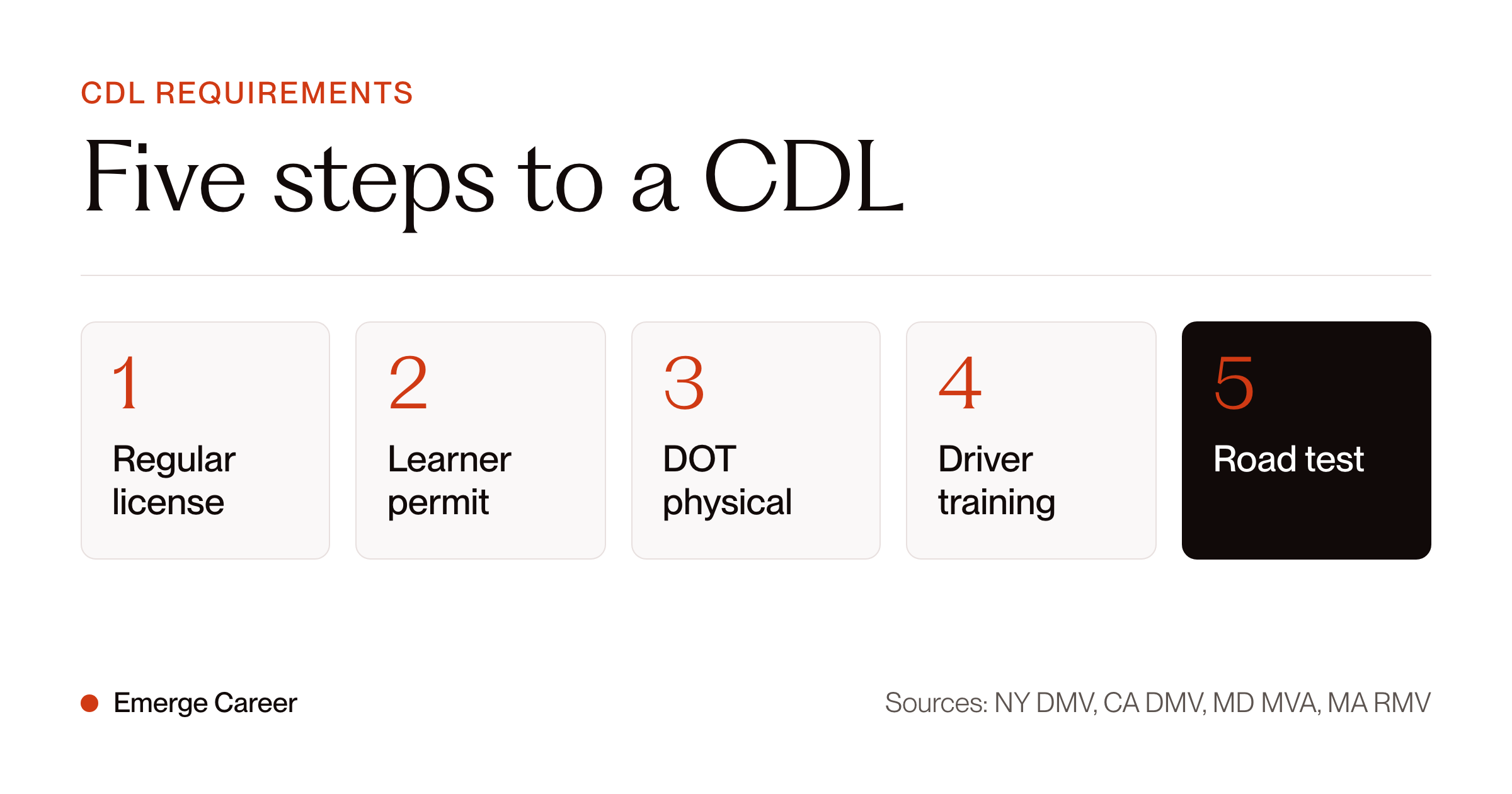
To get a commercial driver license you need five things.
- A regular driver license from the state where you live.
- A commercial learner permit, which you pass a written test to get.
- A DOT medical exam and a medical certificate.
- Entry-Level Driver Training from a school on the federal registry.
- A passing score on the road test, which you can take after you have held the permit for 14 days.
Your state issues the license. The federal government sets the floor that every state has to meet.
Who sets CDL requirements?
Two sets of rules apply at the same time.
The Federal Motor Carrier Safety Administration sets the minimum. Age limits, the medical exam, the training requirement, and the 14-day permit wait are the same in every state. No state can drop below them.
Your state motor vehicle agency runs the process. It decides what documents you bring, what you pay, how many times you can retake a test, and how long your permit stays valid. Those parts differ, and they are the parts that trip people up.
Check your own state before you plan around anything in this guide. The four states we work in are covered below.
How old do I have to be, and what license do I need first?
You must be 18 to drive a commercial vehicle inside your own state. You must be 21 to cross state lines, carry hazardous materials, or carry passengers. Maryland and Massachusetts both state these limits directly.
Most jobs that pay well are interstate jobs. If you are under 21, plan for local work first.
You also need a regular license already in hand. New York asks for a Class D, Class E, or Non-CDL C license. California asks for a noncommercial Class C license. Maryland asks for a valid full Maryland license. Massachusetts asks for a Class D license that stays valid for the whole life of your permit.
Every state asks for proof of who you are. That means identity, date of birth, Social Security number, and proof that you live in the state. Massachusetts adds two conditions that catch people out. You cannot hold a driver license in another state, and you have to be clear of outstanding obligations to any state.
Do I need a Class A, Class B, or Class C CDL?
The class you apply for depends on the vehicle you plan to drive.
Class A
Combination vehicles. A tractor-trailer is the common example. This is the class with the widest range of jobs and the highest pay.
Class B
Heavy straight vehicles. Box trucks, dump trucks, and large buses. The vehicle is one piece instead of a tractor pulling a trailer.
Class C
Smaller vehicles that carry hazardous materials, or that carry 16 or more passengers.
Most Emerge students train for Class A because it opens the most work. See CDL jobs for what each class pays.
When do I get my Commercial Learner's Permit?
The permit comes first. You study the commercial driver manual for your state, then take a written knowledge test at a motor vehicle office.
Once you have the permit, you have to hold it before you can take the road test. California states the rule as holding the permit for at least 14 days. New York states it from the other side: you cannot schedule a road test within 14 days of the day your permit was issued. Both come from the same federal rule.
Permits expire. California issues a permit good for a maximum of 180 days and lets you renew it once for another 180 days, as long as that falls inside one year of your first application. California also voids the whole application if you have not finished within 12 months.
What happens at the DOT physical?
You need a medical exam from an examiner listed on the federal National Registry. The examiner fills out two forms: the Medical Examination Report, form MCSA-5875, and the Medical Examiner Certificate, form MCSA-5876. California names both forms in its application steps.
The exam covers vision, hearing, blood pressure, and conditions that affect your ability to drive safely. Some conditions do not stop you. They require extra paperwork or a shorter certificate.
Book this early. A medical issue you did not know about is the most common reason a timeline slips.
What is Entry-Level Driver Training?
Entry-Level Driver Training, or ELDT, became federal law on February 7, 2022. You have to complete it at a provider listed on the FMCSA Training Provider Registry. A school that is not on the registry does not count.
ELDT applies when you are getting a Class A or Class B CDL for the first time, upgrading from Class B to Class A, or adding a passenger, school bus, or hazardous materials endorsement for the first time.
The timing differs by what you are applying for. For a road test, you finish ELDT first. For a hazardous materials endorsement, you finish ELDT before the knowledge test, not before the road test. Maryland and Massachusetts both state this split.
Check the registry before you pay any school. Emerge covers training at licensed schools for students in our program.
What tests do I have to pass?
The knowledge test comes first and gets you the permit. Massachusetts requires a general knowledge exam, plus a combination vehicle exam if you are going for Class A, plus a hazardous materials or passenger exam if you are going for Class C.
You do not get unlimited tries. California gives you three attempts at each knowledge test. Fail the same test three times and your application is dead, so you start over and pay again.
New York offers written tests in English, Spanish, Chinese, and Russian. The hazardous materials test is English only.
The road test has three parts. A pre-trip inspection, where you walk the vehicle and name what you are checking. A basic control skills test, which is backing and maneuvering. A road test in traffic.
The pre-trip inspection fails more people than the driving does. It is memorization, and it rewards practice.
Failing a test is not the end of it. Ka-son Davis, a graduate from Manhattan, failed a test during his training and went on to get his license. "They like, no listen, we still going to help you. Just as long as you keep pushing, then we going to guide you there."
What are the CDL requirements in New York, California, Maryland, and Massachusetts?
These are the state-run parts. Everything else follows the federal rules above.
| Requirement | New York | California | Maryland | Massachusetts |
|---|---|---|---|---|
| License you need first | Class D, Class E, or Non-CDL C | Noncommercial Class C | Valid full Maryland license | Class D, valid for the life of the permit |
| Age | Federal limits apply | Federal limits apply | 18 in state, 21 interstate, hazmat, passengers | 18 in state, 21 interstate |
| Wait before road test | Cannot schedule within 14 days of permit | Hold permit at least 14 days | ELDT first | ELDT first |
| Permit test fee | $10 | Application fee, valid 12 months | Not listed | $30 |
| Road test fee | $40 | Not listed | Not listed | Not listed |
| Endorsement fee | Not listed | Not listed | Not listed | $10 with permit, $30 later |
| Retakes | Not listed | 3 per knowledge test, then reapply | Not listed | Not listed |
| Permit validity | Not listed | 180 days, one 180-day renewal | Not listed | Not listed |
| Background step | Fingerprints. Surrender any out-of-state CDL | 10-Year History Record Check, form DL 939 | Proof of identity, age, SSN, residency | No license in another state. No outstanding obligations |
The New York page does not state age limits or ELDT on its main CDL page. The federal rules still apply. Confirm the current fees with your own state before you budget.
What can disqualify me from a CDL?
Maryland publishes the clearest list. Your CDL can be disqualified if you get a citation for a high blood alcohol concentration while driving a commercial vehicle, and that happens before any conviction. It can be disqualified if you refuse or fail a chemical test for alcohol. It can be disqualified by a conviction, or by probation before judgment, on certain violations.
If Maryland sends you a disqualification notice, you have 15 days to return it. You can request a hearing, or give up the hearing and surrender the license.
Short disqualifications of 60, 90, 120, or 180 days let you apply for reinstatement without retaking the knowledge and skills tests. Longer ones do not.
Can I get a CDL with a criminal record?
Yes, in most cases. This is the question we get most, and the answer has three separate parts that people run together.
The license
Federal law only bars you from a CDL if you used a commercial vehicle in your offense. Offenses committed in a commercial vehicle carry specific disqualification periods. An offense that had nothing to do with a commercial vehicle does not bar you by itself.
The employer
A carrier can set its own hiring policy, and most do. Policies vary by the offense, how long ago it was, and the route. This gate is separate from the license, and it is the one that decides whether you get hired.
The security screening
A hazardous materials endorsement requires a federal security threat assessment through the Transportation Security Administration. That screening has its own disqualifying offense list, and it is stricter than the CDL rules. You can hold a CDL and still be denied a hazmat endorsement.
Getting the license and getting hired are two different problems. Emerge's employment coaches help students navigate both. We cover the second one in jobs for felons.
How much does a CDL cost, and how long does it take?
Published state fees are small. New York charges $10 for the permit test and $40 for the road test. Massachusetts charges $30 for the permit application.
Training is the real cost. Private CDL schools generally run several thousand dollars, and that is the number that stops most people.
How long it takes depends on whether you can train full time. Ka-son Davis started with Emerge in October 2025. His permit took about a month, because he was working at the same time and had to fit studying around it. Getting the CDL itself took another five to six months.
If you can train full time, pass each test on the first attempt, and get appointments without a wait, seven to twelve weeks is achievable. Working through it, or retaking a test, pushes it closer to Ka-son's six months. Appointment backlogs are the other common delay. Plan for the longer end and treat the short end as the best case.
Ka-son is a single father and wants local work rather than long haul, for the stability. "I'm looking for a career that's got longevity, so I can take care of my kids."
Emerge Career covers training for students in our program at no cost. Our graduates average $75,000 a year. Check whether you qualify at the link at the top of this page.
Sources
- New York State Department of Motor Vehicles, Get a CDL. Permit test fee, road test fee, prerequisite license, 14-day road test rule, test languages, fingerprinting.
- California Department of Motor Vehicles, Commercial Driver Licenses. Permit application steps, 14-day hold, medical forms MCSA-5875 and MCSA-5876, form DL 939, three-attempt limit, 180-day permit validity.
- Maryland Motor Vehicle Administration, Get or renew a CDL. Age limits, vehicle classes, ELDT registry requirement and hazmat timing.
- Maryland Motor Vehicle Administration, Disqualification and reinstatement. Disqualifying events, 15-day notice, reinstatement periods.
- Massachusetts Registry of Motor Vehicles, Apply for a Commercial Learner Permit. Age limits, prerequisite license, residency and obligation rules, exam list, ELDT effective date, permit and endorsement fees.
- Federal Motor Carrier Safety Administration, Commercial Driver License program and the Training Provider Registry.
- Ka-son Davis, Emerge Career graduate, interviewed at the Next Mile Economic Opportunity Summit. Permit and licensing timeline, and retaking a failed test. Video.