Thank you! Your submission has been received!
Emerge Career gets people free training and real jobs in the trucking, diesel mechanic, and HVAC industries. To apply for our program, click here.
Written by Gabriel Saruhashi, co-founder of Ameelio. LinkedIn profile. Last reviewed September 2026.
If you are searching for jobs for felons, or for second-chance jobs, you are asking the right question at the wrong level. The question is not whether anyone hires people with records. They do, every week. The question is which employers, for which roles, and what you need in hand before you apply.
The short answer
People with felony convictions get hired into skilled trades work, and the pay is not entry-level pay.
You do not have to take our word for the numbers. CBS News reported in May 2025 that in fiscal year 2024, 94% of participants in our New York City program graduated, every graduate received a job offer, and the average starting salary was $75,000. At that point 260 formerly incarcerated people had completed it.
Our own cohort records say the same thing. In Connecticut, 30 students enrolled, 94% graduated, and 100% were placed, at an average starting base of $75,313. In Denver, 15 students enrolled and all of them graduated and were placed, at an average base of $76,000.
One of our graduates, Iovanny M., went from $12,000 a year on food stamps to more than $100,000 a year in under twelve months. He is in a union job with full benefits.
Those are small cohorts. We are not claiming they predict your outcome. We are saying the door is open, and we can show you who walked through it.
What counts as a second-chance job
A second-chance job is one where the employer considers applicants with criminal records instead of screening them out automatically. Some people call it fair-chance hiring. The two terms mean the same thing.
It does not mean the employer ignores your record. It means they weigh it alongside everything else, and a conviction on its own does not end the application.
Second-chance jobs are not a separate category of work. They are ordinary jobs at employers who decided to hire this way. Most of the ones our graduates take are driving, waste hauling, transit, and skilled trades roles.
No employer is a permanent second-chance employer. Policies change with leadership, insurance, and the role being filled. That is why the section on checking a policy below matters more than any list you will find online.
What actually decides a hiring decision
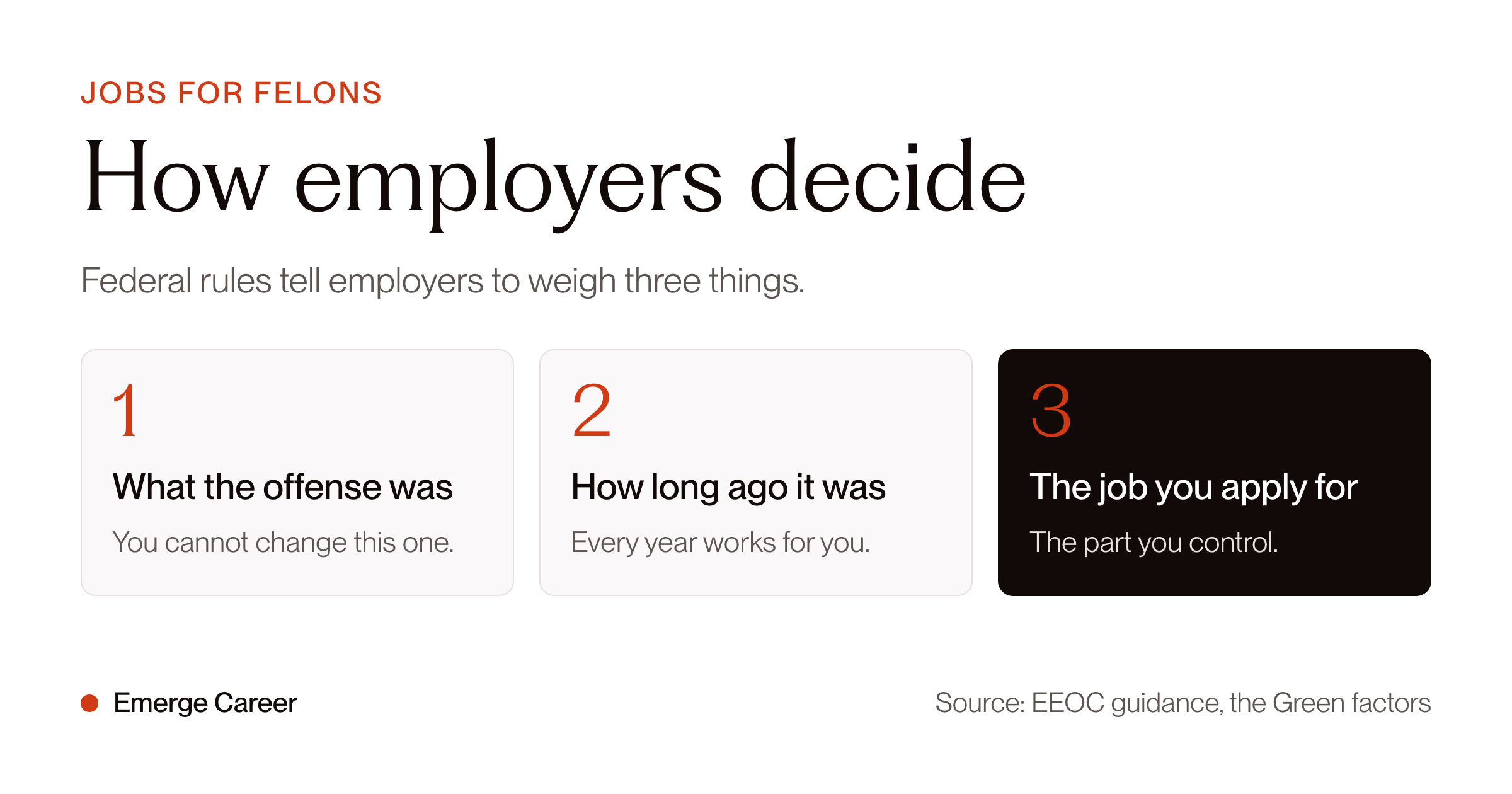
Federal guidance tells employers what to weigh. The Equal Employment Opportunity Commission points to three factors, known as the Green factors:
- The nature and gravity of the offense.
- The time that has passed since the offense or since you finished your sentence.
- The nature of the job you are applying for.
The same guidance says employers should give you a chance to explain your circumstances before they rule you out. That is called an individualized assessment. The EEOC lists what it should take into account: the facts of the offense, your work history since, evidence of rehabilitation, character references, and whether you are bondable.
Two of those three factors you cannot change. Time passed is the one that moves in your favor every month. The third one, the nature of the job, is the one you control right now by choosing what to apply for.
Careers you can start in weeks
Skilled trades hire on licenses and tests rather than on degrees and referrals. That works in your favor.
Commercial driving
There is real demand behind this one. The American Trucking Associations put the industry shortage at about 60,000 drivers when CBS News covered our program. Our graduates average $75,000. The licensing rules are federal and public, so you can check your own eligibility before you spend anything. See CDL requirements.
One thing to know up front: a felony conviction does not bar you from a CDL by itself. The federal rule turns on whether a commercial vehicle was used in the offense. Employer policy is a separate gate, and so is the security screening for a hazardous materials endorsement.
Diesel mechanic
Shops hire on skill, and the work is inside a facility rather than on a customer doorstep. That removes an objection some employers raise. See diesel mechanic jobs.
HVAC
Licensed work with apprenticeship hours built in, so you earn while you qualify. See HVAC jobs.
Employers who have hired our graduates
Named employers, what they told us, and the date we last checked.
Four employers at the Next Mile Economic Opportunity Summit
On September 2, 2026 we ran the Next Mile Economic Opportunity Summit. Four employers sent representatives to meet graduates in person:
- Cream-O-Land Dairy, represented by Daviani Cordero
- Gate Group, represented by Daniela Meza
- MTA, represented by Patrick Densen
- Swissport, represented by Mark Walker
Daniela Meza of Gate Group described the experience level they look for: "We're looking for somebody who has a little bit of experience but not a lot." Gate Group had already hired an Emerge graduate, Daryl Lopez. In her words, he was given the opportunity "because he seemed like he would be a good fit into our operation."
One of the four employers had three more graduates starting the next day: Jamal, Kevin, and Patrick.
Another put the screen plainly: "We just need your skill and compliance. Everything else works itself out, because what we try to do is we try to promote success."
A third explained why they came: "We're a company about giving second chances. So this kind of fit that bill." That recruiter spoke with more than 50 people over the day, and said the reason was personal: "I've been given opportunities, and because I was given those opportunities, I want to pay it forward."
Last verified September 2, 2026.
Interstate Waste Services
We ran a CDL hiring event at the Brooklyn Public Library on April 16, 2026. Forty-eight students showed up. Interstate Waste Services collected more than 30 resumes that day and hired two graduates within weeks. They then committed to hiring at least 50 more through a Driver Helper to CDL Driver pathway, which lets someone start before they hold the license and move up once they do. David Brown Sr., MBA, their Director of Safety, drove that partnership.
Metropolitan Transportation Authority
An MTA recruiter, Shariza Baksh-Ramroop, left one of our New York hiring events with 10 resumes. Five graduates advanced to interviews and four went into the bus operator track. Three Emerge graduates were already on staff before that event.
Every one of these came out of an in-person hiring event rather than an online application. That is the pattern worth copying.
How to find fair-chance employers
Four channels work better than scrolling job boards.
- Hiring events run by training programs. The recruiter is in the room because they already decided to consider people with records.
- Industries with driver or technician shortages. Waste hauling, transit, freight, aviation services, and facilities maintenance all hire on skill.
- State workforce agencies. They administer the bonding and tax credit programs employers use, so they know which local employers use them.
- Reentry organizations in your city. They keep current lists because their funding depends on placements.
Job boards are worth less than any of these, because a posting tells you nothing about the policy behind it.
How to check what a policy really is
Ask the recruiter directly, early, before you invest a week in an application. A short version that works:
"I have a felony conviction from [year]. I have my CDL and a clean driving record. Does your company consider applicants with records, and is there anything about the offense or the timeframe that would rule me out here?"
A real answer sounds specific. It names a lookback period, or an offense category, or says the decision goes to a review. A brush-off sounds like "we consider everyone on a case-by-case basis" with nothing after it. Take the specific answer seriously and keep moving past the vague one.
When to bring up your record
Many states and cities have ban-the-box laws that stop employers from asking about convictions on the initial application. The rules differ by where you live, and by employer size. Check your own state law rather than assuming.
Practical version: do not lead with it, do not hide it, and do not let the background check be the first time they hear about it. Bring it up once you have shown what you can do, and keep it to two sentences. What happened, when, and what you have done since. Then move to the work.
If your background report is wrong
Background reports carry errors. Sealed cases show up. Charges that were dismissed get reported as convictions. Records belonging to someone with a similar name get attached to yours.
Under the Fair Credit Reporting Act, an employer has to give you a copy of the report and a notice before they reject you over it. That notice is your opening. Dispute the error with the screening company in writing, keep a copy, and tell the employer you have filed a dispute.
Pull your own record before you start applying. Fixing an error takes weeks, and it is better to spend those weeks before an offer is on the table.
Programs that make employers say yes
Employers respond to risk and cost. Two federal programs address both, and knowing their names in an interview is worth more than it sounds.
The Work Opportunity Tax Credit is a federal tax credit for employers who hire people from target groups that face barriers to employment. The employer has to get certification that you belong to a target group before they claim it. Our employer page puts the typical credit at around $6,000 per person.
The Federal Bonding Program provides fidelity bond coverage at no cost to the employer, which covers them against loss for an at-risk new hire. The EEOC guidance lists bonding as one of the things an employer should weigh in an individualized assessment.
You can raise both. "I am WOTC eligible and I can be bonded" turns your record into a line item the employer can account for.
What Emerge does
We train people for CDL, diesel mechanic, and HVAC work, and the training is free. We have graduated more than 500 people across three states.
Our New York City program runs with the Mayor's Office of Criminal Justice. CBS News covered it in May 2025, and NBC News has reported on the program as well.
Every student gets a Student Success Coach for the first year on the job, not just until placement. We run hiring events where employers show up to meet graduates in person.
Angel G. of Haverhill, Massachusetts was incarcerated nine years before he came to us. Joe G. of Staten Island said he chose Emerge because we gave an opportunity to people with records that other programs did not.
To check whether you qualify, use the link at the top of this page.
Questions people ask
What is a second-chance job?
A job at an employer who considers applicants with criminal records rather than screening them out automatically. Fair-chance hiring is the same thing under a different name.
Can a felon get a CDL?
Yes, in most cases. The federal disqualification rules turn on whether a commercial vehicle was used in the offense. Employer policy and hazmat screening are separate questions.
How long do I have to wait after a conviction?
There is no single waiting period. Time elapsed is one of the three factors the EEOC tells employers to weigh, so the answer improves the further out you are.
Do I have to tell an employer about my record?
If they ask, yes. Lying about it is the thing most likely to cost you the job after you have it. Ban-the-box laws in many places delay when they can ask.
Which industries hire the most people with records?
In our experience: freight, waste hauling, transit, aviation services, warehousing, construction, and facilities maintenance.
What if the background check shows something wrong?
Dispute it with the screening company in writing. Under federal law the employer has to give you the report and a notice before rejecting you over it.
Is Emerge training actually free?
Yes. The program is government funded and costs students nothing.
Sources
- CBS News, Jobs program for the formerly incarcerated seeks to address U.S. trucking industry shortage, May 21, 2025. Fiscal year 2024 graduation rate, job offers, average starting salary, completions to date, and the driver shortage figure.
- U.S. Equal Employment Opportunity Commission, Enforcement Guidance on the Consideration of Arrest and Conviction Records in Employment Decisions. The three Green factors and the individualized assessment.
- U.S. Department of Labor, Work Opportunity Tax Credit. Target groups and the certification requirement.
- Federal Bonding Program. Fidelity bonding for at-risk hires.
- Next Mile Economic Opportunity Summit, September 2, 2026. Employer representatives on the record: Daviani Cordero (Cream-O-Land Dairy), Daniela Meza (Gate Group), Patrick Densen (MTA), Mark Walker (Swissport). Video.
- Emerge Career, Interstate Waste Services partnership. Event date, resume count, hires, and the Driver Helper pathway.
- Emerge Career, MTA partnership. Recruiter, resume count, interviews, and graduates on staff.
- Emerge Career, Impact. Connecticut and Denver cohort sizes, graduation rates, placement rates, and starting salaries.