Thank you! Your submission has been received!
Emerge Career gets people free training and real jobs in the trucking, diesel mechanic, and HVAC industries. To apply for our program, click here.
Written by Gabriel Saruhashi, co-founder of Ameelio. LinkedIn profile. Last reviewed September 2026.
You have the license and no miles. Postings say "no experience required" and then the recruiter asks how long you have been driving. This guide explains that gap and what to do about it.
The demand is real. The American Trucking Associations put the industry short about 60,000 drivers, a figure CBS News cited in May 2025 when it covered our program. Carriers need drivers. They still have to clear an insurance floor before they can hire you. Both of those are true at once, and that is the gap this guide is about.
What "no experience" means in a listing
"No experience required" usually means no verifiable driving history is required. It rarely means no screening.
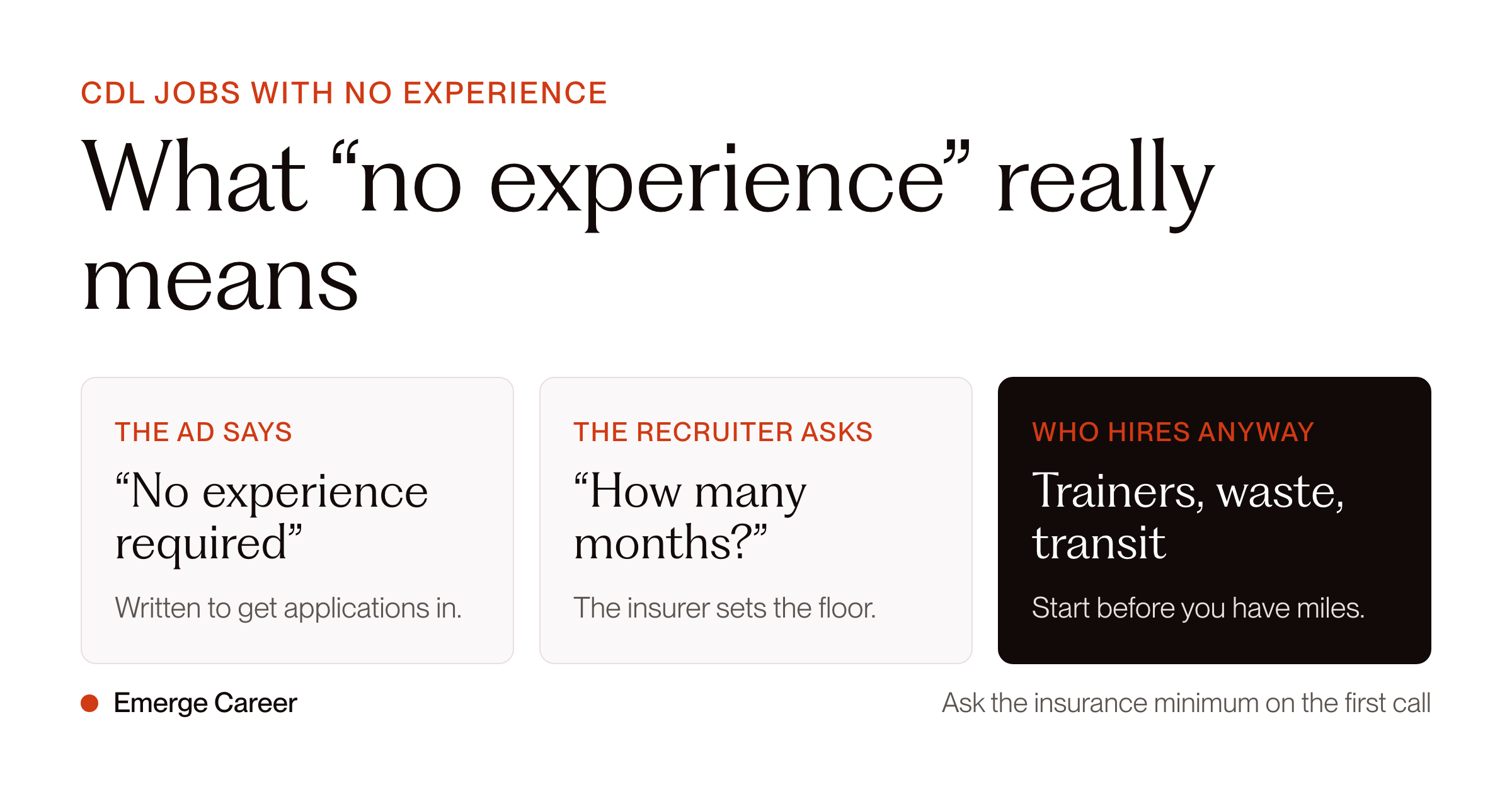
Behind most of those postings sits an insurance minimum. The carrier's insurer sets a floor for what it will cover, and that floor is written in months of seat time. A recruiter who likes you still cannot put you in a truck the policy will not cover.
This is why you get "no experience required" in the ad and "how many months do you have" on the phone. The ad is written by marketing. The floor is written by an underwriter.
Some employers will tell you the floor directly. Daniela Meza of Gate Group, speaking at the Next Mile Economic Opportunity Summit on September 2, 2026, put it this way: "We're looking for somebody who has a little bit of experience but not a lot." Gate Group had already hired an Emerge graduate, Daryl Lopez. That is the shape of a realistic first job. Not zero screening, and not two years of miles either.
Two kinds of employers get around it. Carriers that run their own training or mentor programs absorb the risk internally. Employers outside long-haul freight, like waste hauling and transit, often use different insurance structures and hire on the license.
What you need before you apply
Have these in hand before you send anything.
- Your CDL, with the correct class and any endorsements the job lists.
- A current medical certificate.
- A copy of your own motor vehicle record. Pull it yourself and read it.
- Your last ten years of address and employment history. Federal applications require it, and gaps you have not accounted for will stall the file.
- A phone number you answer and a voicemail that is set up.
That last one is not filler. Recruiters work a list. The applicant who picks up moves forward.
The jobs most open to new CDL holders
Ranked by how reachable they are in your first week of applying.
Carrier training and mentor programs
You drive with a trainer for a set number of weeks, then go solo. These are built for people in your position, so the answer is not going to be "come back with six months."
Waste hauling
Local routes, home nightly, and steady demand. Some run a helper-to-driver pathway, where you start on the back of the truck and move into the seat.
Transit and municipal work
Bus operator roles, public agency pay scales, and benefits. The hiring process is slower and more formal, and a record is handled through a defined review rather than a silent rejection.
Class B local and delivery
Box trucks, dump trucks, and route delivery. Lower ceiling than Class A, faster to get into.
OTR, regional, local, and Class B
New drivers get told long-haul is the only door. It is not, and it is worth understanding what you are choosing.
| Type | Home time | Ease of getting hired new | Notes |
|---|---|---|---|
| Over the road | Out for weeks | Easiest | Most training programs are here. Highest mileage pay. |
| Regional | Home weekly | Moderate | Common second job after some months. |
| Local | Home nightly | Harder | Waste and delivery are the openings. |
| Team | Out for weeks | Easy | Higher pay, shared cab. |
| Class B local | Home nightly | Moderate | Lower pay, quicker entry. |
If you need to be home at night, say so early and target waste, transit, and delivery. Do not take an over the road job planning to quit in a month. Short job stays are the thing that hurts your next application.
What employers and insurers screen for
Four things decide most applications.
Your motor vehicle record. Moving violations matter more than most applicants expect, and a recent suspension is harder to get past than an old conviction.
The Drug and Alcohol Clearinghouse. A violation here stops you until you complete the return-to-duty process. Carriers query it before hiring.
Employment gaps. Not the gap itself. The unexplained gap. Account for the time and it stops being a problem.
Insurance minimums. The one you cannot argue with. Ask about it directly and you will save yourself a week.
How to find jobs that take recent grads
Search on the words carriers actually use in postings for new drivers: "recent graduate," "student driver," "CDL training program," "mentor program," "will train." "Entry level" alone pulls in too many postings with a hidden experience floor.
In-person hiring events beat online applications. At our April 2026 hiring event at the Brooklyn Public Library, one employer collected more than 30 resumes in a day and hired two of our graduates within weeks. An MTA recruiter at another event left with 10 resumes and moved five people into interviews. None of that happens through an online form.
Four employers came to the Next Mile Economic Opportunity Summit on September 2, 2026: Cream-O-Land Dairy, Gate Group, MTA, and Swissport. One of them had three graduates starting the next day. Here is what they said on the day.
Ask your school or program who is hiring their graduates right now. That list is current in a way job boards are not.
How to read a company-sponsored training contract
Company-paid training is a loan with your time as collateral. Read it before you sign, and get answers on four points.
- The commitment period. How many months you owe them.
- The repayment amount. The full number, and whether it shrinks month by month or stays whole until the end.
- What triggers repayment. Quitting is obvious. Being fired, being laid off, or failing a test may also trigger it.
- How it is collected. Payroll deduction, a bill, or a collections referral.
Ask for the contract in writing before orientation. If a recruiter will not send it, that is your answer about how the rest will go.
Emerge covers training at no cost and with no repayment obligation, so this does not apply to our students.
Comparing offers
Run every offer down the same list on the call.
- Pay structure. Cents per mile, hourly, or percentage.
- Guaranteed minimum pay during training and the first months.
- Realistic weekly miles, not the maximum.
- Home time in writing.
- The date benefits start.
- Any repayment exposure.
- Who pays for the permit, the physical, and the endorsements.
An offer with a lower rate and a guaranteed minimum often pays more in month one than a high rate with no freight.
A seven-day application plan
Day 1. Pull your motor vehicle record. Write out ten years of addresses and employers. Fix your voicemail.
Day 2. Build one application packet you can reuse. License, medical card, record, history.
Day 3. Apply to 10 employers. Mix carrier training programs, waste, and transit.
Day 4. Apply to 10 more. Call every one you applied to on day 3.
Day 5. Call the day 4 list. Ask each recruiter one question: what is your experience minimum, and do you have a program for new graduates?
Day 6. Follow up on anything warm. Ask for a specific next step and a date.
Day 7. Review. Any employer who has not answered in three business days moves to the back. Add 10 new ones.
Most of our students apply to 10 to 15 employers before the right fit. Volume and follow-up do the work.
If you have a record
Federal law only bars you from earning a CDL if you used a commercial vehicle in your offense. Employer policy is a separate question, and so is the security screening for a hazardous materials endorsement. Emerge's employment coaches help students navigate these rules.
Ask recruiters about their policy early rather than waiting for the background check. Full detail is in our guide to jobs for felons.
What our graduates did
More than 500 people have graduated from our programs across three states. Our graduates average $75,000 a year.
Our largest program is Next Mile NYC, which we run with the New York City Mayor's Office of Criminal Justice. CBS News reported in May 2025 that 94% of that program's participants graduated in fiscal year 2024, that every graduate received a job offer, and that the average starting salary was $75,000. At that point 260 people had completed it.
The other sites look the same. In Connecticut, 94% of our students graduated and every graduate was placed, at an average starting base of $75,313. In Denver, every student graduated and was placed, at an average base of $76,000.
Iovanny M. went from $12,000 a year to more than $100,000 in under twelve months, in a union job with full benefits.
If you are an Emerge student, your coach knows which employers are hiring new graduates this month and can put your name in front of them. If you are not, check whether you qualify using the link at the top of this page.
Next: CDL requirements if you are still working on the license, or CDL jobs for pay and route breakdowns.
Sources
- CBS News, Jobs program for the formerly incarcerated seeks to address U.S. trucking industry shortage, May 21, 2025. The American Trucking Associations driver shortage figure, and the New York City program's fiscal year 2024 graduation rate, job offers, average starting salary, and completions to date.
- Federal Motor Carrier Safety Administration, Drug and Alcohol Clearinghouse. Pre-employment query requirement and return-to-duty process.
- Federal Motor Carrier Safety Administration, Commercial Driver License program. Licensing and disqualification rules.
- Next Mile Economic Opportunity Summit, September 2, 2026. Daniela Meza (Gate Group) on the experience level they look for, and the hire of Daryl Lopez. Employers present: Cream-O-Land Dairy, Gate Group, MTA, Swissport. Video.
- Emerge Career, Next Mile NYC Economic Opportunity Summit. Program scale in New York City.
- Emerge Career, Interstate Waste Services partnership. April 2026 hiring event, resumes collected, and hires.
- Emerge Career, MTA partnership. Recruiter, resumes, and interviews.
- Emerge Career, Impact. Graduation and placement rates and starting salaries.