Thank you! Your submission has been received!
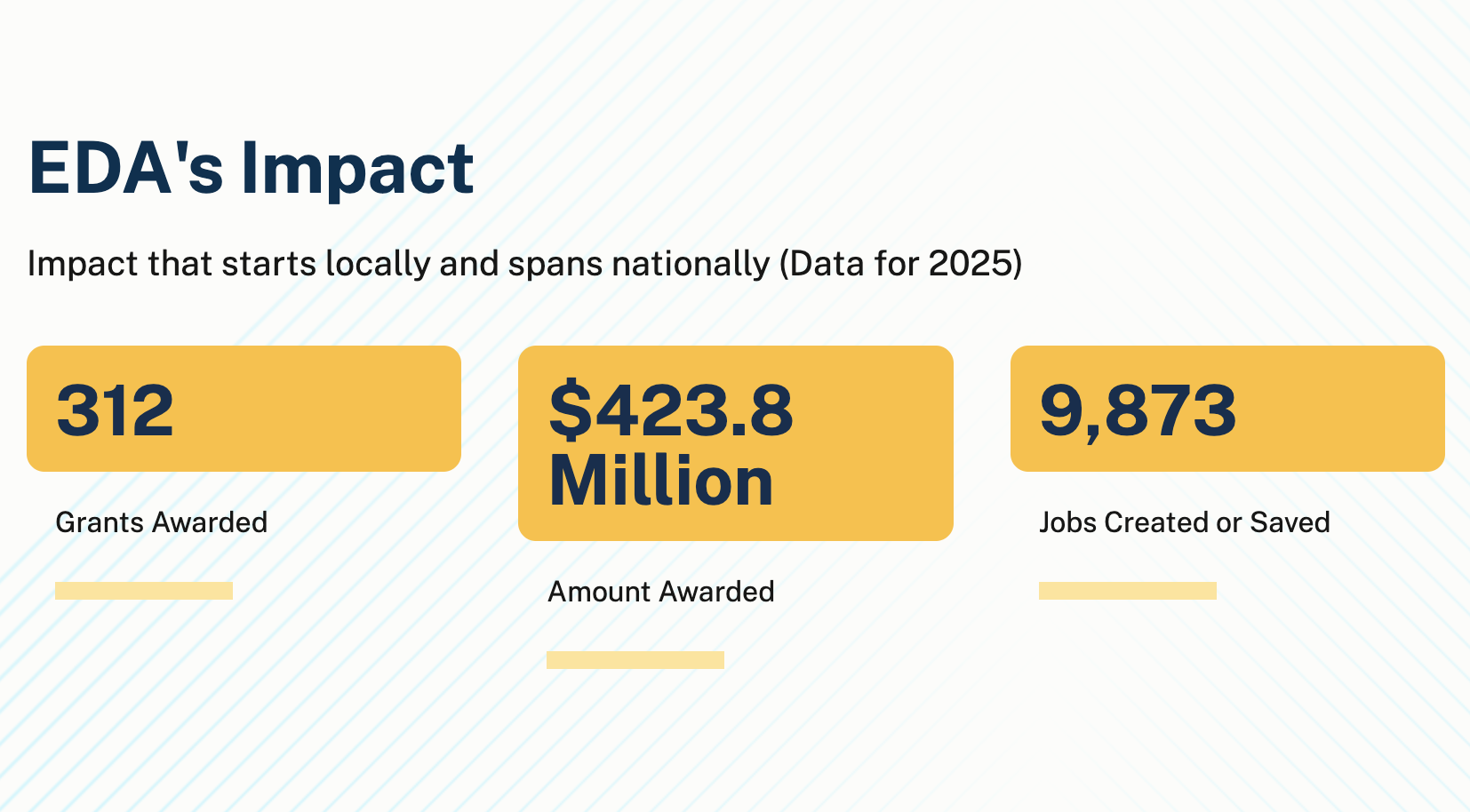
The U.S. Economic Development Administration publishes three numbers on the front page of its website, under a heading that reads "EDA's Impact" and a line that reads "Data for 2025": 312 grants awarded, $423.8 million awarded, and 9,873 jobs created or saved. The agency supplies both the numerator and the denominator, under the word Impact, and leaves the division to the reader. It comes to $42,925 per job.
Two things make that figure softer than it looks, and one makes it harder. The award total and the job count are both 2025 figures, but they are not the same cohort: EDA's capital grants produce jobs over several years, so the dollars and the jobs on that panel belong to different vintages. Against that, "created or saved" combines new positions with ones that already existed, and EDA's own definitions page separates the two before the homepage adds them back together. The cost of a genuinely new job is higher than $42,925, and the agency does not publish how much higher.
The number a state agency weighs that against is what the same person costs when nobody trains them. The New York City Comptroller put the cost of holding one person in city custody at $500,000 in 2023, and California's Legislative Analyst's Office put its state average at $127,800 per incarcerated person for the 2025-26 fiscal year, both of them annual figures that recur for every year the person stays held.
That roughly is the standing cost of the population Emerge enrolls.
Emerge Career places people into skilled trades careers for a fraction of $42,925. Since 2021 we have made more than 500 placements, at an average starting salary of $75,000 as of September 2026.
The payment condition is also checkable even where the price is not. EDA's $42,925 is an appropriation: obligated first, counted afterward by the grantees themselves, in a reporting cycle that runs years behind the award, which is how a homepage panel can be current and the figure under it still unsettled. Emerge is paid on delivery, when the credential and the job are verified rather than when a seat is filled. And when a placement does not happen, the state has spent very little.
Every Emerge student is justice-involved. That is the enrollment criterion rather than just a characteristic of the cohort, and it is why the $500,000 and the $127,800 above are the relevant denominators: a graduate placed into a $75,000 job comes off a corrections budget that was already paying for them. Five hundred placements at $75,000 is $37.5 million in annual starting wages. What the two numbers share is the public dollar spent per working person, which is the line a budget office compares across programs.
Emerge's value to the city is thus dramatically more pronounced.
So a government has two ways to buy a job. It can appropriate the money first and count the jobs later, at something over $42,925 each, in a program whose own reporting cannot yet say how many of those jobs are new. Or it can pay on delivery, for someone whose alternative is already costing between $127,800 and $500,000 a year, and pay nothing when the placement does not happen. Both are legitimate uses of public money. Only one of them puts the risk on the vendor.
Emerge Career trains justice-involved people for CDL, HVAC, diesel tech, and other skilled trades careers across Massachusetts, New York, California, and Colorado. If you run a economic development, workforce, corrections, or reentry budget and want to connect further please reach out!